

Updated Mar 18, 2026 Test Engine to Practice Test for C-THR81-2505 Valid and Updated Dumps
Exam Questions for C-THR81-2505 Updated Versions With Test Engine
SAP C-THR81-2505 Exam Syllabus Topics:
| Topic | Details |
|---|---|
| Topic 1 |
|
| Topic 2 |
|
| Topic 3 |
|
| Topic 4 |
|
NEW QUESTION # 34
Which permission controls a user's access to the Edit button in the history of Job Information?
- A. Job Information Actions > View History
- B. Edit Link > Edit/Insert
- C. Job Information Actions > Correct
- D. Job Information Actions > Edit/Insert
Answer: C
Explanation:
Job Information Actions > Correct permission controls the Edit button in the Job Information history.
This permission allows users to correct existing records without creating a new effective-dated record. It ensures that only authorized users can make retroactive changes to historical data.
Other permissions, such as Edit Link > Edit/Insert, Job Information Actions > Edit/Insert, or Job Information Actions > View History, do not directly control access to the Edit button in the history section.
NEW QUESTION # 35
Which steps are required to set up the Auto Delegation feature for a workflow in Employee Central? Note: There are 2 correct answers to this question.
- A. Define the delegate relationship in Employee Central.
- B. Enable the field in the Corporate Data Model.
- C. Enable the auto-delegate permission for users.
- D. Enable the field in Succession Data Model.
Answer: B,C
Explanation:
To set up the Auto Delegation feature in Employee Central workflows, the following steps are required:
Enable Auto-Delegate Permission: Users must have the auto-delegate permission enabled, which allows them to define their delegates for workflows.
Enable Auto-Delegation in the Corporate Data Model: This configuration ensures that the system recognizes and supports the auto-delegation functionality at the framework level.
Correct Answers:
B: Enable the auto-delegate permission for users.
D: Enable the field in the Corporate Data Model.
NEW QUESTION # 36
How do you create country/region-specific fields (CSF) for a country that does NOT have pre- delivered Legal Entity CSF fields? Note: There are 3 correct answers to this question.
- A. Create a composite association on the new generic object to Legal Entity.
- B. Update the condition and condition values of the association.
- C. Create a new generic object.
- D. Update the field criteria of the association.
- E. Create a composite association to the new generic object on Legal Entity.
Answer: C,D,E
Explanation:
To create country/region-specific fields (CSF) for a country that does not have pre-delivered Legal Entity CSF fields, follow these steps:
Create a New Generic Object: Develop a new generic object to define the specific fields required for the country/region. This object will store the additional data fields pertinent to the Legal Entity.
Create a Composite Association to the New Generic Object on Legal Entity: Establish a composite association from the Legal Entity to the newly created generic object. This association links the Legal Entity to the country/region-specific fields, enabling the system to recognize and utilize these fields appropriately.
Update the Field Criteria of the Association: Modify the field criteria within the association to ensure that the new fields are correctly associated with the Legal Entity. This step involves setting conditions that determine when the new fields are applicable, based on factors such as country/region.
These steps align with the standard procedures for extending the data model in SAP SuccessFactors Employee Central to accommodate country/region-specific requirements.
NEW QUESTION # 37
How do you set the Event Reason Derivation rule to ensure event reasons are NOT overwritten?
- A. Set the IF statement to Always True and set the THEN statement as blank.
- B. Set the IF statement to check if the event reason value is NULL and set the THEN statement as blank.
- C. Set the IF statement to check if the event reason value is NOT NULL and set the THEN statement as blank.
- D. Set the IF statement to check if the event reason value is blank and set the THEN statement to NULL.
Answer: A
Explanation:
To ensure that event reasons are not overwritten, the business rule should be configured as follows:
Set the IF statement to Always True: This ensures the rule is triggered every time.
Set the THEN statement as blank: This ensures that no new event reason value overwrites the existing one.
By following this configuration, the system avoids unnecessary overwriting of existing event reason values while processing changes.
NEW QUESTION # 38
An employee is changing their Last Name, so a CC workflow notification should be sent to their manager when is the CC workflow notification sent out?
- A. When the workflow is sent back by any approver
- B. When the employee initiates the workflow
- C. When the approvers decline the workflow
- D. When the workflow is approved by all approvers
Answer: D
Explanation:
When an employee changes their last name and a workflow is triggered, the CC workflow notification is sent to the manager once all approvers have approved the workflow. This ensures that the notification is only sent after the change is confirmed and finalized, aligning with best practices for workflow communication.
Scenario 2: Approvals for Self-Service
NEW QUESTION # 39
Which HRIS elements share the same People Profile block? Note: There are 2 correct answers to this question.
- A. personalinfo and globalinfo
- B. compInfo and payComponentRecurring
- C. personInfo and globalinfo
- D. jobinfo and organizationInfo
Answer: A,B
Explanation:
In SAP SuccessFactors Employee Central, the People Profile is designed to consolidate related HRIS elements into cohesive blocks for streamlined data management. Specifically, the compInfo (Compensation Information) and payComponentRecurring (Recurring Pay Components) HRIS elements share the same People Profile block. Similarly, the personalinfo (Personal Information) and globalinfo (Global Information) HRIS elements are grouped together within the People Profile. This structured grouping enhances the user experience by providing a unified view of related employee information.
NEW QUESTION # 40
What tags are supported in alert messages?
Note: There are 2 correct answers to this question.
- A. [[SUBJECT_USER]]
- B. [[RECIPIENT_NAME]]
- C. [[HRIS_ELEMENT]]
- D. [[EVENT_REASON]]
Answer: A,D
Explanation:
SAP SuccessFactors Employee Central supports specific tags in alert messages to provide dynamic content.
The following tags are supported:
* [[SUBJECT_USER]]: Refers to the user for whom the alert is generated.
* [[EVENT_REASON]]: Refers to the event reason triggering the alert.
Correct Answers:
* A: [[SUBJECT_USER]]
* B: [[EVENT_REASON]]
NEW QUESTION # 41
You have updated several position departments using Import and Export data, but the incumbent's data still shows the previous information for the department hris-field.
What are some possible causes for this data inconsistency? Note: There are 2 correct answers to this question.
- A. The business rule to sync data changes sets the Job Information.Department to be equal to Job Information.Position.Department.
- B. The technicalParameters value has NOT been set to SYNC in the position records.
- C. The business rule to sync data changes sets the Position Department to be equal to Job Information.Department.
- D. The technicalParameters column with a value of SYNC has NOT been included in the import file.
Answer: C,D
Explanation:
B . The technicalParameters column with a value of SYNC has NOT been included in the import file:
When importing position data, the technicalParameters column with the value "SYNC" must be included to ensure that changes to position attributes are synchronized to the incumbent's data.
C . The business rule to sync data changes sets the Position Department to be equal to Job Information.Department:
If the rule is incorrectly configured, the department field on the incumbent's job information may not update as expected. The correct configuration should align the position department with the incumbent's job information.
These factors contribute to discrepancies between position and incumbent data.
NEW QUESTION # 42
Manager A initiated a job code change for Employee X with an effectivity date of January 15. Another manager initiated the same request, but for January 30. What happens to the workflows triggered by both transactions?
- A. The system will cancel the second workflow.
- B. The system will cancel the first workflow.
- C. The system will reject both workflows.
- D. The system will allow both workflows to continue.
Answer: D
Explanation:
When two workflows are initiated for the same employee with different effective dates, both workflows are allowed to proceed independently. The system processes them sequentially based on their respective effective dates. This ensures that updates are recorded in the order they occur without rejecting either workflow.
Other options, such as canceling or rejecting workflows, do not align with standard system behavior for managing multiple transactions.
NEW QUESTION # 43
An HR admin/Global Mobility person must create a transfer for an employee. The employee will be moving from Position A in Team A to Position B in Team B. Both managers will have to approve the transfer.
How do you configure a two-step workflow so that the approval goes first to the current manager and second to the future manager?
- A. By selecting in Step 1. Role-Manager - Source
* By selecting in Step 2: Role - Manager - Target - B. By selecting in Step 1. Position Relationship - Parent Parent Position - Source
* By selecting in Step 2: Position Relationship - Parent Position - Target - C. By selecting in Step 1: Role - Self-Source
* By selecting in Step 2. Role- Manager - Target - D. By selecting in Step 1: Role - Manager - Source
* By selecting in Slep 2. Role-Manager Manager - Target
Answer: A
Explanation:
Scenario 2: Approvals for Self-Service
To configure a two-step workflow where the approval first goes to the current manager and then to the future manager, you must set the following in the workflow:
Step 1: Role - Manager - Source (current manager of the employee).
Step 2: Role - Manager - Target (future manager of the employee).
This setup ensures that the workflow sequentially routes approval to both the current and future managers.
NEW QUESTION # 44
Which of the following standard behaviors in Position Management can be set differently using Position Types? Note: There are 3 correct answers to this question.
- A. Respect workflow at Copy Position in Position Organizational Chart
- B. Set or reset TBH status if an incumbent's FTE is changed
- C. Define a specific transition period for a group of positions
- D. Trigger workflows on Job Information if the position changes are synchronized to the incumbents
- E. Transfer incumbents of the lower-level positions to a new manager if the current manager leaves their position
Answer: A,B,D
Explanation:
Position Management in SAP SuccessFactors supports different behaviors for position types, allowing tailored management practices. The following behaviors can be configured differently based on position types:
A . Trigger workflows on Job Information if the position changes are synchronized to the incumbents:
Specific workflows can be triggered for updates, such as when a position change impacts the employee(s) occupying that position.
B . Respect workflow at Copy Position in Position Organizational Chart:
Workflow rules for copying positions can be customized, ensuring approval processes align with organizational requirements.
E . Set or reset TBH (To Be Hired) status if an incumbent's FTE is changed:
Position types can define whether the TBH status is updated automatically based on changes to an incumbent's FTE.
These behaviors enable organizations to manage diverse scenarios and requirements in position administration efficiently.
NEW QUESTION # 45
Which of the following are features of the clean core dashboard? Note: There are 2 correct answers to this question.
- A. It can be accessed by using SAP For Me.
- B. Customers can grant access to the dashboard to partners.
- C. Customers can use the dashboard in the dev, test, and production tenants.
- D. It can be used in all SAP S/4HANA Cloud editions.
Answer: A,B
Explanation:
The clean core dashboard offers tools to monitor and maintain clean core operations.
Access via SAP For Me: The dashboard can be reached through the SAP For Me portal, a customer-centric interface for managing SAP environments.
Partner Access: Customers can grant partners access to the clean core dashboard, allowing collaborative management and monitoring.
The dashboard's functionality in specific tenants (like dev, test, production) or availability across all SAP S/4HANA Cloud editions depends on the specific system configurations.
NEW QUESTION # 46
Due to confidentiality reasons, when the HR Business Partner (maintained in Job Relationship) is creating a change in salary for an employee, this action will need to be approved by the manager of the HR Business Partner creating the request.
How do you define this in the workflow when filling in the Approver Type, Approver Role, Context, and Relationship to Approver? Refer to the screenshot to answer the question
- A. By selecting in Step 1: Role - Employee HR - Source - Employee
- B. By selecting in Step 1: Role - Self-Source - Initiator
- C. By selecting in Step 1: Role - Manager - Source - Initiator
- D. By selecting in Step 1: Role - Employee HR-Source- Initiator
Answer: C
Explanation:
To ensure that the salary change initiated by the HR Business Partner is approved by their manager, you need to configure the workflow with the following details:
Approver Type: Manager
Approver Role: Manager
Context: Initiator (this ensures the approval request is routed to the manager of the person initiating the workflow).
Relationship to Approver: From the initiator's position, the system derives the relationship to their manager.
Selecting Role: Manager - Source: Initiator in Step 1 aligns with these requirements.
Scenario 2: Approvals for Self-Service
NEW QUESTION # 47
What does it mean when a position is subjected to capacity control?
- A. The standard hours are checked to prevent the position from being overstaffed.
- B. The target FTE is checked to prevent the position from being understaffed.
- C. The standard hours are checked to prevent the position from being understaffed.
- D. The target FTE is checked to prevent the position from being overstaffed.
Answer: D
Explanation:
When a position is subjected to capacity control in SAP SuccessFactors Employee Central, the system checks the target Full-Time Equivalent (FTE) to ensure that the position is not overstaffed. Capacity control enforces constraints on the maximum number of employees or FTEs that can occupy a position, helping organizations manage resources effectively and avoid exceeding the predefined limits. This feature is particularly useful for managing budgetary and organizational constraints.
NEW QUESTION # 48
Your client is live with the employee transfer process in the production instance. The workflow shown in the screenshot is triggered when an employee transfer is initiated.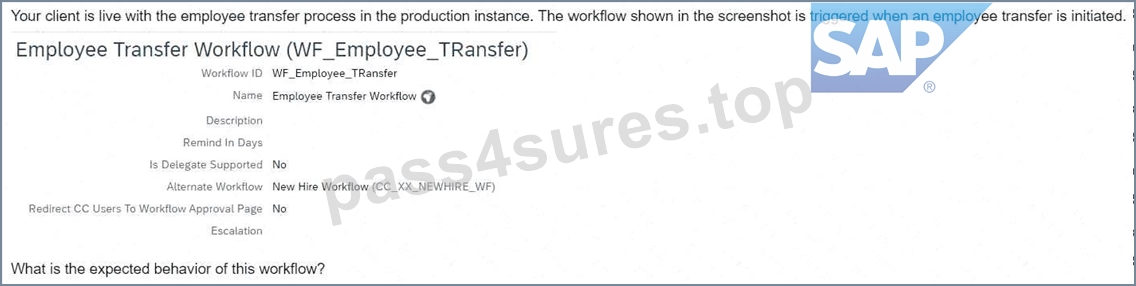
What is the expected behavior of this workflow?
- A. The alternate workflow is used when there is a future-dated record entered for the employee.
- B. An approver can automatically reroute this request to another employee during vacation.
- C. If an approver does NOT take any action for 3 days, a reminder notification is sent by the system.
- D. The initiator of the employee transfer process is given an option to choose New Hire Workflow as an alternate workflow to WF_Employee_Transfer.
Answer: A
Explanation:
In the scenario where an employee transfer process is initiated, and a workflow is triggered, the system behavior is as follows:
* Alternate Workflow Usage: If there is a future-dated record entered for the employee, the system utilizes the alternate workflow. This mechanism ensures that the appropriate workflow is applied based on the effective date of the transaction, allowing for accurate processing of future-dated changes.
This functionality is designed to handle scenarios where actions need to be taken in advance, ensuring that the system processes the correct workflow when the future-dated record becomes effective.
NEW QUESTION # 49
......
C-THR81-2505 Exam Dumps - Free Demo & 365 Day Updates: https://prep4tests.pass4sures.top/SAP-Certified-Associate/C-THR81-2505-testking-braindumps.html