

Full CEM Practice Test and 146 unique questions with explanations waiting just for you!
Energy Management Dumps CEM Exam for Full Questions - Exam Study Guide
NEW QUESTION # 42
At the end of a performance contract, who owns the equipment installed by the project?
- A. The energy service company
- B. The bank
- C. The equipment manufacturer
- D. The company that paid the contract payments
Answer: D
NEW QUESTION # 43
The temperature in an unconditioned mechanical room is found to typically be around 23°C warmer than ambient air. If the air intake of an air compressor located in the mechanical room is routed through a nearby wall so that ambient air is fed directly to the air compressor's intake, what impact can be expected on the air compressor's energy requirement?
- A. No measureable change in energy use
- B. Decrease energy use by 3.8%
- C. Decrease energy use by 7.6%
- D. Increase energy use by 3.8%
- E. Increase energy use by 7.6%
Answer: C
NEW QUESTION # 44
A 100-kW electrical load has a power factor of 75%. What capacitance, in KVAR, will improve the power factor to 95%?
- A. 15.7 kVAR
- B. 55.3 kVAR
- C. 45.2 kVAR
- D. 25.3 kVAR
- E. 33.1 kVAR
Answer: D
NEW QUESTION # 45
When comparing two similar facilities, you see that the facility with newer, higher-efficiency equipment has a higher energy-use index [EUI] (kJ/m²-yr). What might be the cause?
- A. The facility with the higher efficiency equipment should have a higher EUI
- B. The facility with the lower EUI is in need of commissioning
- C. The facility with the higher EUI is in need of commissioning
- D. The facility with the lower EUI requires a performance contract
- E. The facility with the higher EUI requires a supervisory control and data acquisition (SCADA) system
Answer: C
Explanation:
1) CEM Principle: Equipment Efficiency # System Performance
The AEE CEM Body of Knowledge stresses that higher-efficiency equipment does not guarantee lower energy use unless systems are:
* Properly commissioned
* Correctly controlled
* Operated as designed
2) Evaluation of Options
* A. The facility with the higher EUI is in need of commissioning #
* Most common cause per CEM case studies: controls, sequences, and integration not optimized.
* B. The facility with the lower EUI is in need of commissioning #
* Lower EUI indicates better performance.
* C. The facility with the lower EUI requires a performance contract #
* No evidence supports this.
* D. The facility with the higher efficiency equipment should have a higher EUI #
* Contradicts energy efficiency principles.
* E. The facility with the higher EUI requires a SCADA system #
* Monitoring alone does not correct poor performance.
CEM Exam Insight
Commissioning ensures that high-efficiency equipment actually delivers expected energy performance.
NEW QUESTION # 46
A 3 MW rated wind-powered turbine has a rotor diameter of 113 meters. What is the efficiency of the wind turbine at rated power if it is operating in wind power calculated at 8.6 MW? Assume an air density of 1.225 kg/m³.
- A. 42.7%
- B. 59.3%
- C. 34.9%
- D. 28.4%
Answer: C
NEW QUESTION # 47
Which of the following is NOT a renewable-energy resource?
SELECT THE CORRECT ANSWER
- A. Crop residue
- B. Geothermal heat
- C. Saw grass
- D. Shale gas
- E. Ocean waves
Answer: D
Explanation:
Renewable energy resources are naturally replenished on a human timescale. Let's evaluate each option:
A:Saw grass:A biomass resource, renewable through regrowth.
B:Shale gas:A fossil fuel extracted from shale formations, non-renewable.
C:Geothermal heat:Energy from Earth's internal heat, renewable.
D:Ocean waves:Mechanical energy from ocean surface waves, renewable.
E:Crop residue:Organic materials from agriculture, renewable.
Conclusion:
Shale gas is not a renewable energy resource. Therefore, the correct answer is B.
NEW QUESTION # 48
What is the best type of heat exchanger to recover and transfer latent heat energy from one air stream to another?
- A. Desiccant heat wheel
- B. Shell and tube
- C. Run-around system
- D. Heat pipe
- E. Ceramic recuperator
Answer: A
NEW QUESTION # 49
A fully-loaded heat pump unit delivers 36-kW thermal heating with a power draw of 12-kW electric. What is the coefficient of performance (COP) at full load?
- A. 2.0
- B. 4.0
- C. 5.0
- D. 3.0
- E. 6.0
Answer: B
NEW QUESTION # 50
An energy-saving project costs $540,000. The project will have maintenance costs of $25,000 per year. The energy savings from the project are $160,000 per year. What is the simple payback of the project?
- A. 3.0 years
- B. 4.0 years
- C. 5.0 years
- D. 2.0 years
Answer: B
Explanation:
To determine the simple payback period for the energy-saving project, we need to apply the standard formula used in energy management as per the Association of Energy Engineers (AEE) Certified Energy Manager (CEM) guidelines. The simple payback period is a widely used metric in energy efficiency projects to evaluate how long it takes for the initial investment to be recovered through net savings. Let's break this down step-by-step using the provided data and CEM-aligned methodology.
Step 1: Understand the Simple Payback Formula
* Formula: Simple Payback Period (years)=Initial Investment CostNet Annual Savings\text{Simple Payback Period (years)} = \frac{\text{Initial Investment Cost}}{\text{Net Annual Savings}} Simple Payback Period (years)=Net Annual SavingsInitial Investment Cost
* Definition: The simple payback period represents the time (in years) required for the cumulative savings to equal the initial investment, without considering the time value of money (e.g., discount rates or inflation).
* CEM Reference: AEE CEM training materials emphasize this formula in the "Energy Economics" section, where simple payback is a fundamental tool for assessing project feasibility.
Step 2: Identify Given Data
* Initial Investment Cost: $540,000 (one-time cost of the project).
* Annual Energy Savings: $160,000 per year (benefit from the project).
* Annual Maintenance Costs: $25,000 per year (additional cost incurred due to the project).
* Net Annual Savings: This must account for both the savings and the costs incurred annually.
Step 3: Calculate Net Annual Savings
* Definition: Net annual savings is the difference between the annual energy savings and any additional annual costs (e.g., maintenance).
* Verification: The problem specifies maintenance costs as an ongoing expense tied to the project, which reduces the effective savings. CEM guidelines require including such costs in payback calculations unless explicitly stated otherwise.
Step 4: Compute the Simple Payback Period
* Apply the Formula: Simple Payback Period=Initial Investment CostNet Annual Savings\text{Simple Payback Period} = \frac{\text{Initial Investment Cost}}{\text{Net Annual Savings}} Simple Payback Period=Net Annual SavingsInitial Investment Cost Simple Payback Period=540,
000135,000=4.0 years\text{Simple Payback Period} = \frac{540,000}{135,000} = 4.0 \, \text{years} Simple Payback Period=135,000540,000=4.0years
* Result: The payback period is exactly 4.0 years, meaning it takes 4 years for the net savings to recover the initial investment.
Step 5: Validate Against Options
* Options:A. 2.0 yearsB. 3.0 yearsC. 4.0 yearsD. 5.0 years
* Check:
* If we ignored maintenance costs (incorrectly), payback would be 540,000160,000=3.375 \frac
{540,000}{160,000} = 3.375 160,000540,000=3.375 years, which rounds to 3.4-not an exact match for any option.
* With maintenance costs included, 540,000135,000=4.0 \frac{540,000}{135,000} = 4.0
135,000540,000=4.0, which matches option C precisely.
* Conclusion: Option C (4.0 years) is correct based on the net savings approach.
NEW QUESTION # 51
Natural gas costs $4.80/GJ. How much does it cost to heat 500 liters of water from 18°C to 50°C using a natural gas water heater with an efficiency of 85%? [The efficiency and fuel price are both based on HHV.
The specific heat of water (C) is 4.2 kJ/kg-°C.]
- A. $1.44
- B. $0.76
- C. $0.38
- D. $0.25
- E. $1.25
Answer: B
Explanation:
To calculate the cost of heating water using natural gas:
Step 1: Compute Energy Required to Heat the Water
Given:
* Mass of water = 500 L = 500 kg
* Temperature rise (#T) = 50°C - 18°C = 32°C
* Specific heat of water (Cp) = 4.2 kJ/kg-°C
Energy Required (Q)=m×Cp×#T
=500×4.2×32
=67,200 kJ=67.2 MJ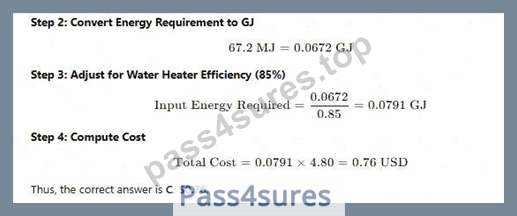
NEW QUESTION # 52
A high-pressure steam system passes 180°C condensate (saturated liquid) through a steam trap to an atmospherically vented condensate receiver tank. If the steam trap is working properly, how much of the condensate mass can be lost out the vent of the receiver tank in the form of flash steam?
- A. 100%
- B. 15%
- C. 25%
- D. 66%
- E. 6%
Answer: C
NEW QUESTION # 53
Using a degree-day base of 18°C, calculate the number of cooling degree days (CDD) if the outside temperature is a uniform 25°C throughout the year (365 days/year).
- A. 1,845 CDD/yr
- B. 2,975 CDD/yr
- C. 1,955 CDD/yr
- D. 2,555 CDD/yr
- E. 2,250 CDD/yr
Answer: D
NEW QUESTION # 54
What term describes the difference between the control signal value and the set point?
- A. Dead time
- B. Dead band
- C. Error or offset
- D. Cut off
- E. Differential
Answer: C
NEW QUESTION # 55
If a boiler cycles on and off too frequently, what control can you adjust to reduce the number of times a boiler cycles on and off?
- A. Increase the controller set point
- B. Reduce the controller differential
- C. Increase the controller differential
Answer: B
NEW QUESTION # 56
An outdoor parking area has 25 light poles. Each pole has a 420 Watt (ballast included) high-pressure sodium (HPS) luminaire. The parking area lights are illuminated 4,500 hours per year and the electricity cost is $0.08
/kWh. What is the annual energy cost reduction if each luminaire is replaced with a 220-Watt (driver included) LED luminaire?
- A. $2,200/yr
- B. $1,200/yr
- C. $2,600/yr
- D. $1,500/yr
- E. $1,800/yr
Answer: E
Explanation:
To determine the annual energy cost savings from switching to LED luminaires:
A table with numbers and symbols AI-generated content may be incorrect.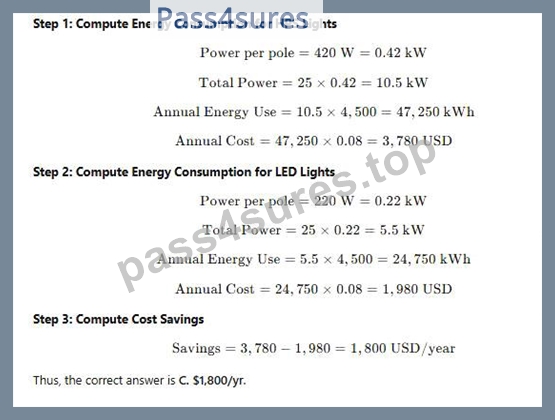
NEW QUESTION # 57
How does an enthalpy-based economizer control operate?
- A. Using the dry-bulb temperature and relative humidity of both the outdoor-air and return-air
- B. Comparing the difference in dry-bulb air temperature measurements of the return air and the outdoor air
- C. Measuring the outdoor air dry-bulb temperature and relative humidity
- D. Using a constant mixed air proportion control sequence
Answer: A
NEW QUESTION # 58
Which type of single-phase alternating-current motor has the highest efficiency?
- A. Electronic-commutated motor
- B. Permanent split-capacitor motor
- C. Shaded-pole motor
Answer: A
NEW QUESTION # 59
Insulation has a thermal conductivity of 0.04 Watt/(m-°C). What is the R-value for this insulation when it is 5- cm thick?
- A. 1.25 (m²-°C)/Watt
- B. 20 Watt/(m²-°C)
- C. 20 (m²-°C)/Watt
- D. 2.20 Watt/m²
- E. 0.8 (m²-°C)/Watt
Answer: A
NEW QUESTION # 60
An air-conditioning unit delivers 10,000 kJ/h (thermal cooling). The equipment uses single-phase electrical power at 220-volt and 5.25 amps with a power factor of 100%. Calculate the coefficient of performance (COP).
- A. 2.4
- B. 13.2
- C. 3.2
- D. 6.2
- E. 16.1
Answer: C
Explanation: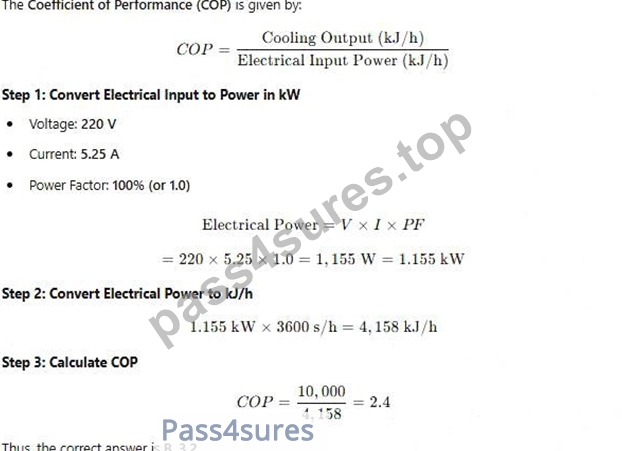
NEW QUESTION # 61
An office building is illuminated with T8 fluorescent lamps. Which of the following is the best schedule for group relamping (total replacement of all the T8 fluorescent lamps in the building)?
- A. When you reach 70% of the rated lamp life
- B. When 20% of the ballasts have failed
- C. When 25% of the lamps have failed
- D. When the building owner changes
- E. Every 4 years
Answer: A
NEW QUESTION # 62
In a performance contract, which group has the greatest investment risk?
- A. The energy-service company
- B. The equipment manufacturer
- C. The company installing the energy project
- D. Risk is shared by the terms in the performance contract
Answer: A
Explanation:
In a guaranteed savings performance contract, the ESCO assumes the greatest financial risk, because:
* Payments are tied to verified savings
* ESCO must compensate shortfalls if savings are not achieved
This principle is explicitly tested in the CEM exam.
NEW QUESTION # 63
......
Authentic Best resources for CEM Online Practice Exam: https://prep4tests.pass4sures.top/Energy-Management/CEM-testking-braindumps.html