

Online Questions - Valid Practice To your EX294 Exam (Updated 35 Questions)
Practice To EX294 - Remarkable Practice On your Red Hat Certified Engineer (RHCE) exam for Red Hat Enterprise Linux 8 Exam Exam
Passing the RedHat EX294 exam results in certification as a Red Hat Certified Engineer (RHCE) for Red Hat Enterprise Linux 8. Red Hat Certified Engineer (RHCE) exam for Red Hat Enterprise Linux 8 Exam certification is recognized worldwide and demonstrates that the individual has the skills and knowledge required to manage and deploy Red Hat Enterprise Linux 8 in complex environments.
To prepare for the RedHat EX294 exam, IT professionals should have a solid understanding of Linux system administration and should have hands-on experience with RHEL 8 systems. They should also be familiar with automation tools, such as Ansible, and should have experience configuring and managing network services, storage, security, and virtualization. IT professionals can prepare for the exam by taking training courses, reviewing study materials, and practicing their skills in a lab environment.
NEW QUESTION # 17
Modify file content.
------------------------
Create a playbook called /home/admin/ansible/modify.yml as follows:
* The playbook runs on all inventory hosts
* The playbook replaces the contents of /etc/issue with a single line of text as
follows:
--> On hosts in the dev host group, the line reads: "Development"
--> On hosts in the test host group, the line reads: "Test"
--> On hosts in the prod host group, the line reads: "Production"
Answer:
Explanation:
Solution as:
# pwd
/home/admin/ansible
# vim modify.yml
---
- name:
hosts: all
tasks:
- name:
copy:
content: "Development"
dest: /etc/issue
when: inventory_hostname in groups['dev']
- name:
copy:
content: "Test"
dest: /etc/issue
when: inventory_hostname in groups['test']
- name:
copy:
content: "Production"
dest: /etc/issue
when: inventory_hostname in groups['prod']
:wq
# ansible-playbook modify.yml --syntax-check
# ansible-playbook modify.yml
NEW QUESTION # 18
Create a file in /home/sandy/ansible/ called report.yml. Using this playbook, get a file called report.txt (make it look exactly as below). Copy this file over to all remote hosts at /root/report.txt. Then edit the lines in the file to provide the real information of the hosts. If a disk does not exist then write NONE.
- A. Solution as:

- B. Solution as:


Answer: B
NEW QUESTION # 19
Create a playbook called issue.yml in /home/sandy/ansible which changes the file /etc/issue on all managed nodes: If host is a member of (lev then write "Development" If host is a member of test then write "Test" If host is a member of prod then write "Production"
Answer:
Explanation:
Solution as:
NEW QUESTION # 20
Create a file in /home/sandy/ansible/ called report.yml. Using this playbook, get a file called report.txt (make it look exactly as below). Copy this file over to all remote hosts at /root/report.txt. Then edit the lines in the file to provide the real information of the hosts. If a disk does not exist then write NONE.
Answer:
Explanation:
Solution as:
NEW QUESTION # 21
Create a playbook called timesvnc.yml in /home/sandy/ansible using rhel system role timesync. Set the time to use currently configured nip with the server 0.uk.pool.ntp.org. Enable burst. Do this on all hosts.
Answer:
Explanation:
Solution as: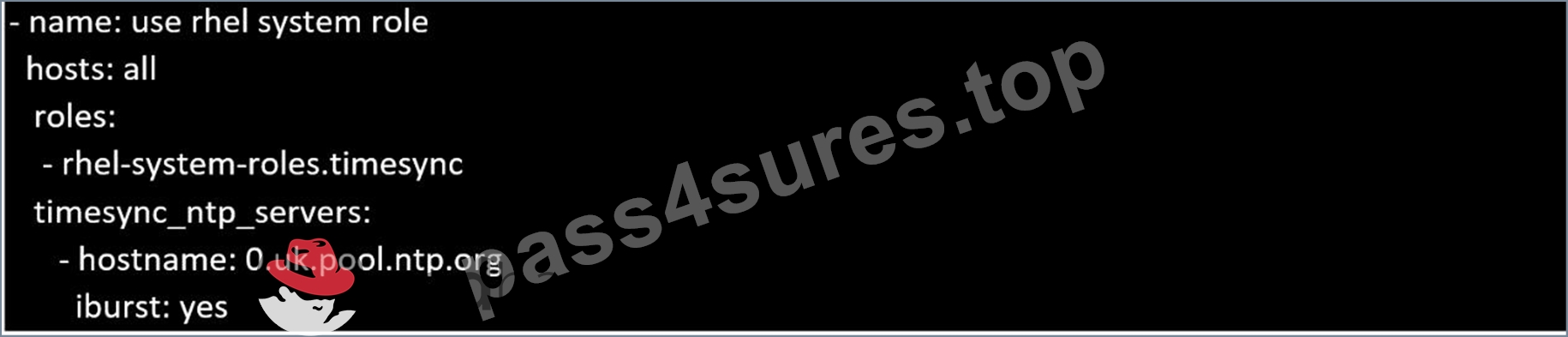
NEW QUESTION # 22
Create a role called sample-apache in /home/sandy/ansible/roles that enables and starts httpd, enables and starts the firewall and allows the webserver service. Create a template called index.html.j2 which creates and serves a message from /var/www/html/index.html Whenever the content of the file changes, restart the webserver service.
Welcome to [FQDN] on [IP]
Replace the FQDN with the fully qualified domain name and IP with the ip address of the node using ansible facts. Lastly, create a playbook in /home/sandy/ansible/ called apache.yml and use the role to serve the index file on webserver hosts.
- A. Option

/home/sandy/ansible/roles/sample-apache/tasks/main.yml
/home/sandy/ansible/roles/sample-apache/templates/index.html.j2
In /home/sandy/ansible/roles/sample-apache/handlers/main.yml
- B. Option
/home/sandy/ansible/roles/sample-apache/tasks/main.yml
/home/sandy/ansible/roles/sample-apache/templates/index.html.j2
In /home/sandy/ansible/roles/sample-apache/handlers/main.yml
Answer: B
NEW QUESTION # 23
Create Logical volumes with lvm.yml in all nodes according to following
requirements.
----------------------------------------------------------------------------------------
* Create a new Logical volume named as 'data'
* LV should be the member of 'research' Volume Group
* LV size should be 1500M
* It should be formatted with ext4 file-system.
--> If Volume Group does not exist then it should print the message "VG Not found"
--> If the VG can not accommodate 1500M size then it should print "LV Can not be
created with
following size", then the LV should be created with 800M of size.
--> Do not perform any mounting for this LV.
Answer:
Explanation:
Solution as:
# pwd
/home/admin/ansible
# vim lvm.yml
---
- name:
hosts: all
ignore_errors: yes
tasks:
- name:
lvol:
lv: data
vg: research
size: "1500"
- debug:
msg: "VG Not found"
when: ansible_lvm.vgs.research is not defined
- debug:
msg: "LV Can not be created with following size"
when: ansible_lvm.vgs.research.size_g < "1.5"
- name:
lvol:
lv: data
vg: research
size: "800"
when: ansible_lvm.vgs.research.size_g < "1.5"
- name:
filesystem:
fstype: ext4
dev: /dev/research/data
:wq!
# ansible-playbook lvm.yml --syntax-check
# ansible-playbook lvm.yml
NEW QUESTION # 24
Create an ansible vault password file called lock.yml with the password reallysafepw in the /home/sandy/ansible directory. In the lock.yml file define two variables. One is pw_dev and the password is 'dev' and the other is pw_mgr and the password is 'mgr' Create a regular file called secret.txt which contains the password for lock.yml.
Answer:
Explanation:
ansible-vault create lock.yml
New Vault Password: reallysafepw
Confirm: reallysafepw
NEW QUESTION # 25
Create a playbook called packages.yml that:
----------------------------------------------
--> Installs the php and mariadb packages on hosts in the dev, test, and prod host
groups.
--> Installs the Development Tools package group on hosts in the dev host group.
--> Updates all packages to the latest version on hosts in the dev host group.
Answer:
Explanation:
Solution as:
# pwd
home/admin/ansible/
# vim packages.yml
---
- name: Install the packages
hosts: dev,test,prod
vars:
- php_pkg: php
- mariadb_pkg: mariadb
tasks:
- name: install the packages
yum:
name:
- "{{ php_pkg }}"
- "{{ mariadb_pkg }}"
state: latest
- name: install the devops tool packages
hosts: dev
tasks:
- name: install devepment tools
yum:
name: "@Development Tools"
state: latest
- name: upgrade all the packages
yum:
name: "*"
state: latest
exclude: kernel*
!wq
# ansible-playbook package.yml --syntax-check
# ansible-playbook package.yml
NEW QUESTION # 26
Install and configure ansible
User sandy has been created on your control node with the appropriate permissions already, do not change or modify ssh keys. Install the necessary packages to run ansible on the control node. Configure ansible.cfg to be in folder /home/sandy/ansible/ansible.cfg and configure to access remote machines via the sandy user. All roles should be in the path /home/sandy/ansible/roles. The inventory path should be in /home/sandy/ansible/invenlory.
You will have access to 5 nodes.
node1.example.com
node2.example.com
node3.example.com
node4.example.com
node5.example.com
Configure these nodes to be in an inventory file where node I is a member of group dev. nodc2 is a member of group test, node3 is a member of group proxy, nodc4 and node 5 are members of group prod. Also, prod is a member of group webservers.
- A. In/home/sandy/ansible/ansible.cfg
[defaults]
inventory=/home/sandy/ansible/inventory
roles_path=/home/sandy/ansible/roles
remote_user= sandy
host_key_checking=false
[privilegeescalation]
become=true
become_user=root
become_ask_pass=false
In /home/sandy/ansible/inventory
[dev]
node 1 .example.com
[test]
node2.example.com
node4.example.com
node5 .example.com
[webservers:children]
prod - B. In/home/sandy/ansible/ansible.cfg
[defaults]
inventory=/home/sandy/ansible/inventory
roles_path=/home/sandy/ansible/roles
remote_user= sandy
host_key_checking=false
[privilegeescalation]
become=true
become_user=root
become_method=sudo
become_ask_pass=false
In /home/sandy/ansible/inventory
[dev]
node 1 .example.com
[test]
node2.example.com
[proxy]
node3 .example.com
[prod]
node4.example.com
node5 .example.com
[webservers:children]
prod
Answer: B
NEW QUESTION # 27
Create a file called adhoc.sh in /home/sandy/ansible which will use adhoc commands to set up a new repository.
The name of the repo will be 'EPEL' the description 'RHEL8' the baseurl is 'https://dl.fedoraproject.org/pub/epel/epel-release-latest-8.noarch.rmp' there is no gpgcheck, but you should enable the repo.
* You should be able to use an bash script using adhoc commands to enable repos.
Depending on your lab setup, you may need to make this repo "state=absent" after you pass this task.
Answer:
Explanation:
chmod 0777 adhoc.sh
vim adhoc.sh
#I/bin/bash
ansible all -m yum_repository -a 'name=EPEL description=RHEL8
baseurl=https://dl.fedoraproject.org/pub/epel/epel-release-latest-8.noarch.rmp
gpgcheck=no enabled=yes'
NEW QUESTION # 28
Create a file called packages.yml in /home/sandy/ansible to install some packages for the following hosts. On dev, prod and webservers install packages httpd, mod_ssl, and mariadb. On dev only install the development tools package. Also, on dev host update all the packages to the latest.
Answer:
Explanation:
Solution as:
** NOTE 1 a more acceptable answer is likely 'present' since it's not asking to install the latest
state: present
** NOTE 2 need to update the development node
- name: update all packages on development node
yum:
name: '*'
state: latest
NEW QUESTION # 29
Create a jinja template in /home/sandy/ansible/ and name it hosts.j2. Edit this file so it looks like the one below. The order of the nodes doesn't matter. Then create a playbook in /home/sandy/ansible called hosts.yml and install the template on dev node at /root/myhosts
- A. Solution as:

- B. Solution as:

Answer: A
NEW QUESTION # 30
Create the users in the file usersjist.yml file provided. Do this in a playbook called users.yml located at /home/sandy/ansible. The passwords for these users should be set using the lock.yml file from TASK7. When running the playbook, the lock.yml file should be unlocked with secret.txt file from TASK 7.
All users with the job of 'developer' should be created on the dev hosts, add them to the group devops, their password should be set using the pw_dev variable. Likewise create users with the job of 'manager' on the proxy host and add the users to the group 'managers', their password should be set using the pw_mgr variable.
Answer:
Explanation:
ansible-playbook users.yml -vault-password-file=secret.txt
NEW QUESTION # 31
Create a playbook that changes the default target on all nodes to multi-user tarqet. Do this in playbook file called target.yml in /home/sandy/ansible
- A. - name: change default target
hosts: all
tasks:
- name: change target
file:
src: /usr/lib/systemd/system/multi-user.target dest: /etc/systemd/system/default.target state: link - B. - name: change default target
hosts: all
- name: change target
file:
src: /usr/lib/systemd/system/multi-user.target dest: /etc/systemd/system/default.target state: link
Answer: A
NEW QUESTION # 32
Create a playbook called hwreport.yml that produces an output file called /root/
hwreport.txt on all managed nodes with the following information:
------------------------------------------------------------------------------------------------------
--> Inventory host name
--> Total memory in MB
--> BIOS version
--> Size of disk device vda
--> Size of disk device vdb
Each line of the output file contains a single key-value pair.
* Your playbook should:
--> Download the file hwreport.empty from the URL http://classroom.example.com/
hwreport.empty and
save it as /root/hwreport.txt
--> Modify with the correct values.
note: If a hardware item does not exist, the associated value should be set to NONE
----------------------------------------------------------------------------------------------
while practising you to create these file hear. But in exam have to download as per
questation.
hwreport.txt file consists.
my_sys=hostname
my_BIOS=biosversion
my_MEMORY=memory
my_vda=vdasize
my_vdb=vdbsize
Answer:
Explanation:
Solution as:
# pwd
/home/admin/ansible
# vim hwreport.yml
- name:
hosts: all
ignore_errors: yes
tasks:
- name: download file
get_url:
url: http://classroom.example.com/content/ex407/hwreport.empty
dest: /root/hwreport.txt
- name: vdasize
replace:
regexp: "vdasize"
replace: "{{ ansible_facts.devices.vda.size }}"
dest: /root/hwreport.txt
register: op1
- debug:
var: op1
- name: none
replace:
regexp: "vdasize"
replace: NONE
dest: /root/hwreport.txt
when:
op1.failed == true
- name: vdbsize
replace:
regexp: "vdbsize"
replace: "{{ ansible_facts.devices.vdb.size }}"
dest: /root/hwreport.txt
register: op2
- debug:
var: op2
- name: none
replace:
regexp: "vdbsize"
replace: NONE
dest: /root/hwreport.txt
when:
op2.failed == true
- name: sysinfo
replace:
regexp: "{{item.src}}"
replace: "{{item.dest}}"
dest: /root/hwreport.txt
loop:
- src: "hostname"
dest: "{{ ansible_facts.fqdn }}"
- src: "biosversion"
dest: "{{ ansible_facts.bios_version }}"
- src: "memory"
dest: "{{ ansible_facts.memtotal_mb }}"
:wq!
# ansible-playbook hwreport.yml --syntax-check
# ansible-playbook hwreport.yml
NEW QUESTION # 33
Rekey an existing Ansible vault as follows:
-----------------------------------------------
* Download Ansible vault from http:// classroom.example.com /secret.yml to /home/
admin/ansible/
* The current vault password is curabete
* The new vault password is newvare
* The vault remains in an encrypted state with the new password
Answer:
Explanation:
Solution as:
# pwd
/home/admin/ansible/
# wget http://classroom.example.com/secret.yml
# chmod 0600 newpassword.txt
# ansible-vault rekey vault.yml --new-vault-password-file=newpassword.txt
NEW QUESTION # 34
Create a playbook called regulartasks.yml which has the system that append the date to /root/datefile every day at noon. Name is job 'datejob'
- A. Solution as:

- B. Solution as:

Answer: B
NEW QUESTION # 35
Use Ansible Galaxy with a requirements file called /home/admin/ansible/roles/
install.yml to download and install roles to /home/admin/ansible/roles from the
following URLs:
http:// classroom.example.com /role1.tar.gz The name of this role should be balancer
http:// classroom.example.com /role2.tar.gz The name of this role should be phphello
Answer:
Explanation:
Solution as:
# pwd
/home/admin/ansible/roles
# vim install.yml
---
- src: http://classroom.example.com/role1.tar.gz
name: balancer
- src: http://classroom.example.com/role2.tar.gz
name: phphello
:wq!
# pwd
/home/admin/ansible
# ansible-galaxy install -r roles/install.yml -p roles
NEW QUESTION # 36
Create a playbook called timesvnc.yml in /home/sandy/ansible using rhel system role timesync. Set the time to use currently configured nip with the server 0.uk.pool.ntp.org. Enable burst. Do this on all hosts.
- A. Solution as:
- B. Solution as:

Answer: A
NEW QUESTION # 37
Install and configure ansible
User sandy has been created on your control node with the appropriate permissions already, do not change or modify ssh keys. Install the necessary packages to run ansible on the control node. Configure ansible.cfg to be in folder /home/sandy/ansible/ansible.cfg and configure to access remote machines via the sandy user. All roles should be in the path /home/sandy/ansible/roles. The inventory path should be in /home/sandy/ansible/invenlory.
You will have access to 5 nodes.
node1.example.com
node2.example.com
node3.example.com
node4.example.com
node5.example.com
Configure these nodes to be in an inventory file where node I is a member of group dev. nodc2 is a member of group test, node3 is a member of group proxy, nodc4 and node 5 are members of group prod. Also, prod is a member of group webservers.
Answer:
Explanation:
In/home/sandy/ansible/ansible.cfg
[defaults]
inventory=/home/sandy/ansible/inventory
roles_path=/home/sandy/ansible/roles
remote_user= sandy
host_key_checking=false
[privilegeescalation]
become=true
become_user=root
become_method=sudo
become_ask_pass=false
In /home/sandy/ansible/inventory
[dev]
node 1 .example.com
[test]
node2.example.com
[proxy]
node3 .example.com
[prod]
node4.example.com
node5 .example.com
[webservers:children]
prod
NEW QUESTION # 38
Create a file called specs.empty in home/bob/ansible on the local machine as follows:
HOST=
MEMORY=
BIOS=
VDA_DISK_SIZE=
VDB_DISK_SIZE=
Create the playbook /home/bob/ansible/specs.yml which copies specs.empty to all remote nodes' path /root/specs.txt. Using the specs.yml playbook then edit specs.txt on the remote machines to reflect the appropriate ansible facts.
- A. Solution as:

- B. Solution as:
Answer: A
NEW QUESTION # 39
......
RedHat EX294 exam is a performance-based exam that requires candidates to perform various tasks related to system administration, networking, security, and automation. It tests candidates' skills in real-world scenarios and assesses their ability to troubleshoot and resolve issues related to Red Hat Enterprise Linux 8 systems. EX294 exam is conducted in a lab environment, and candidates are provided access to a live system to perform the required tasks.
True EX294 Exam Extraordinary Practice For the Exam: https://prep4tests.pass4sures.top/RHCE/EX294-testking-braindumps.html