

MB-820 Practice Exam and Study Guides - Verified By Pass4sures Updated 66 Questions
2024 Updated Verified Pass MB-820 Study Guides & Best Courses
NEW QUESTION # 12
Note: This question is part of a series of questions that present the same scenario. Each question in the series contains a unique solution that might meet the stated goals. Some question sets might have more than one correct solution, while others might not have a correct solution.
After you answer a question in this section, you will NOT be able to return to it. As a result, these questions will not appear in the review screen.
A company creates a Business Central app and a table named MyTable to store records when sales orders are posted.
Users report the following issues:
- The users receive permission errors related to MyTable.
- Users are no longer able to post sales orders since installing the
new app.
- The users cannot access the list page created in MyTable.
You need to resolve the user issues without creating new permission sets. You must use the principle of least privilege.
Solution: Decorate the event subscriber used for inserting data in MyTable by entering (InherentPermissions(PermissionObjectType::TableData. Database::MyTable. 'R')] Does the solution meet the goal?
- A. Yes
- B. No
Answer: A
Explanation:
Using InherentPermissions in an event subscriber with the specified syntax could potentially resolve the permission issues related to MyTable, provided that the permissions specified (in this case, 'R' for Read) align with the minimum necessary for the users to perform their tasks. This approach allows the app to grant permissions dynamically based on the context of the event subscriber, which in this case is involved with inserting data into MyTable. By granting Read permission at the event level, it ensures that users have the necessary permissions to interact with MyTable in the context of the operations facilitated by the event subscriber, without needing to alter existing permission sets or grant broader permissions than necessary. This solution adheres to the principle of least privilege by ensuring that permissions are granted only within the narrow scope needed for specific operations, thereby potentially resolving the reported user issues in a secure and controlled manner.
NEW QUESTION # 13
You are creating an entitlement object in Business Central to enable transactability for AppSource apps.
You must map the entitlement object to a plan in Partner Center.
You need to select the value of the Type property to use in the entitlement object.
Which value should you use?
- A. PerUserServicePlan
- B. Role
- C. Implicit
- D. Unlicensed
Answer: A
Explanation:
In Business Central, when creating an entitlement object to enable transactability for AppSource apps and mapping it to a plan in Partner Center, the Type property of the entitlement object should be set to PerUserServicePlan (A). The PerUserServicePlan type is used to define an entitlement that is based on a service plan, which is typically how transactability features are managed for apps distributed through AppSource. This type of entitlement allows for the mapping of specific features or capabilities of the app to a service plan in Partner Center, enabling granular control over what users are entitled to use based on their subscription. The other values, such as Implicit (B), Unlicensed (C), and Role (D), are used in different contexts and do not apply to the scenario of mapping an entitlement object to a plan for AppSource apps.
NEW QUESTION # 14
A company plans to meet new regulatory requirements.
The regulator has issued new tax tiers.
You need to update the base application table by using a table extension.
Which table field property can you change?
- A. DecimalPlaces
- B. CalcFormula
- C. AutoFormatType
- D. BlankZero
Answer: A
Explanation:
When updating the base application table using a table extension in Microsoft Dynamics 365 Business Central, certain properties of table fields can be modified to meet new requirements, such as regulatory changes. The DecimalPlaces property (B) is one such property that can be adjusted in a table extension. This property determines the number of decimal places that are displayed and stored for decimal fields in the table. Adjusting the DecimalPlaces property can be particularly useful when dealing with financial data and tax calculations that require precision to meet new tax tiers set by a regulator. It's important to note that not all properties can be modified in a table extension; for example, the CalcFormula property (A) cannot be changed as it affects how the field's value is calculated, which could have significant implications on the base application's logic.
NEW QUESTION # 15
Hotspot Question
A company plans to integrate tests with its build pipelines.
The company has two Docker sandbox environments: SandboxA and SandboxB.
You observe the following:
- SandboxA is configured without the Test Toolkit installed.
- SandboxB must be configured from scratch. The Test Toolkit must be
installed in SandboxB during configuration.
You need to configure the sandbox environments.
How should you complete the cmdlets? To answer, select the appropriate options in the answer area.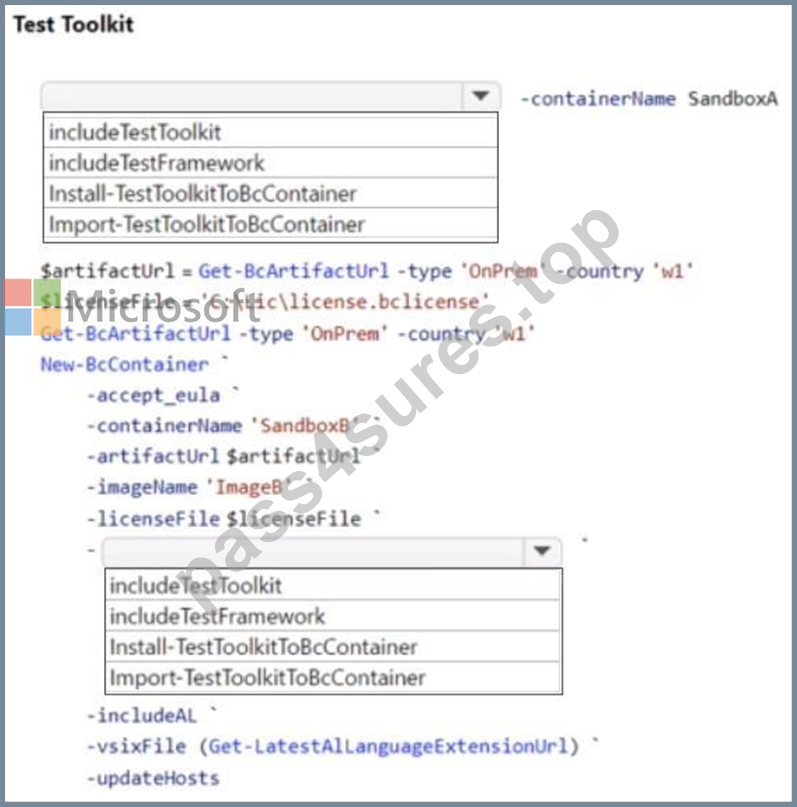
Answer:
Explanation: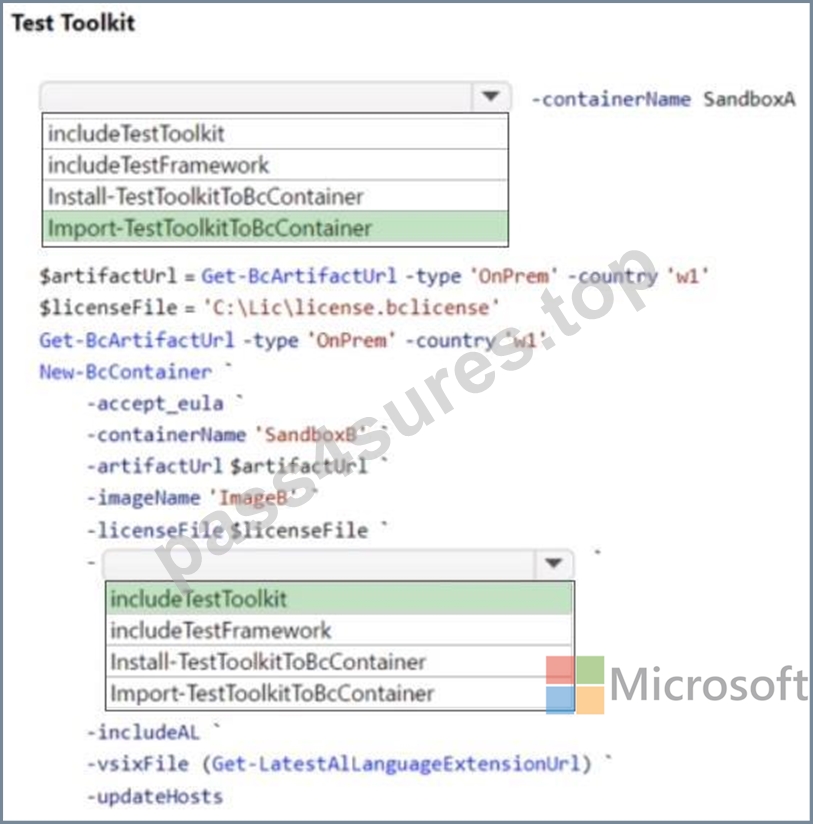
NEW QUESTION # 16
You are developing a test application to test the posting process of a sales order. You must provide the following implementation:
* Specify the value of post options (dialog: Ship, Invoice, Ship & Invoice) as Invoice.
* Perform calculations and values checking.
You need to complete the development of the test codeunit.
Which methods should you use? To answer, move the appropriate methods to the correct implementation. You may use each method once, more than once, or not at all. You may need to move the split bar between panes or scroll to view content.
NOTE: Each correct selection is worth one point.
Answer:
Explanation:
NEW QUESTION # 17
Why is it important to adhere to development standards in Business Central?
- A. To increase the number of users that can be supported
- B. To allow for higher data storage capacity
- C. To ensure code quality and maintainability
- D. To decrease the software license costs
Answer: C
NEW QUESTION # 18
Note: This question is part of a series of questions that present the same scenario. Each question in the series contains a unique solution that might meet the stated goals. Some question set might have more than one correct solution, while others might not have a correct solution.
After you answer a question in this section, you will NOT be able to return to it. As a result, these questions will not appear on the review screen.
A company creates a Business Central app and a table named MyTable to store records when sales orders are posted.
Users report the following issues:
* The users receive permission errors related to MyTable.
* Users are no longer able to post sales orders since installing the new app.
* The users cannot access the list page created in MyTable.
You need to resolve the user issues without creating new permission sets. You must use the principle of least privilege.
Solution: Decorate the event subscriber used for inserting data in MyTable by entering (lnherentPermissions(PermissionOb]ectType:TableDat a. Database:MyTable. 'R')] Does the solution meet the goal?
- A. Yes
- B. No
Answer: A
Explanation:
Using InherentPermissions in an event subscriber with the specified syntax could potentially resolve the permission issues related to MyTable, provided that the permissions specified (in this case, 'R' for Read) align with the minimum necessary for the users to perform their tasks. This approach allows the app to grant permissions dynamically based on the context of the event subscriber, which in this case is involved with inserting data into MyTable. By granting Read permission at the event level, it ensures that users have the necessary permissions to interact with MyTable in the context of the operations facilitated by the event subscriber, without needing to alter existing permission sets or grant broader permissions than necessary. This solution adheres to the principle of least privilege by ensuring that permissions are granted only within the narrow scope needed for specific operations, thereby potentially resolving the reported user issues in a secure and controlled manner.
NEW QUESTION # 19
Hotspot Question
You have a per tenant extension that contains the following code.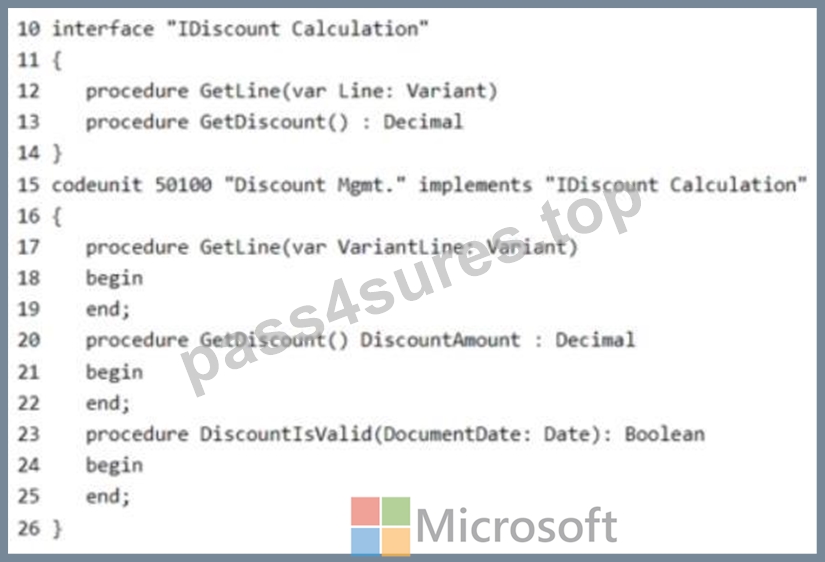
For each of the following statements, select Yes if the statement is true. Otherwise, select No.
NOTE: Each correct selection is worth one point.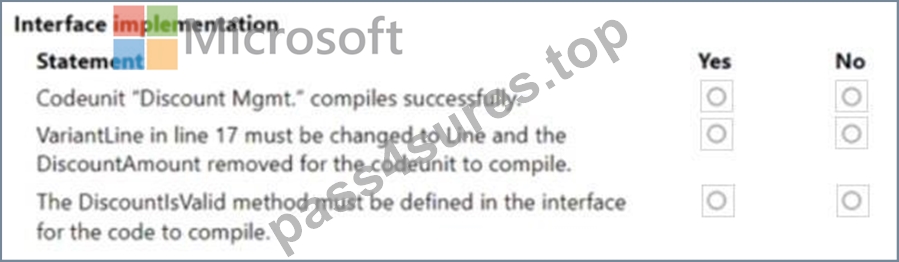
Answer:
Explanation: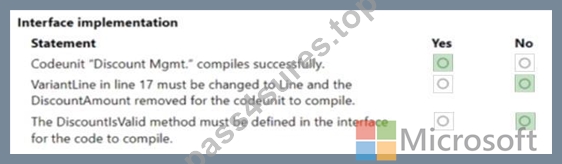
NEW QUESTION # 20
You need to define the data types for the fields of the N on-conformity table.
Which two data types should you use? Each correct answer presents part of the solution.
NOTE: Each correct selection is worth one point.
- A. Integer for the N on-conformity Number field
- B. Date for the Non-Conformity Date field
- C. Date Time for the Non-Conformity Date field
- D. Code for the Non-Conformity Number field
- E. Char for the Non-Conformity Number field
Answer: B,D
Explanation:
In Business Central, fields in tables are assigned specific data types that determine the kind of data they can store. For the Non-conformity table mentioned in the case study, the following data types should be used:
Date for the Non-Conformity Date field: This is because the Non-conformity Date field is required to store only the date when the non-conformity was recorded. The Date data type is appropriate for storing dates without times.
Code for the Non-Conformity Number field: The Non-conformity Number field is described to use alphanumeric values with a format that includes "NC" and the year, like "NC24-001". In Business Central, the Code data type is used for fields that store alphanumeric keys. It is a text field with a limited length, which makes it suitable for number series that contain letters and numbers.
Other options are not suitable:
A) Integer for the Non-conformity Number field: This would not be appropriate because the Non-conformity Number includes alphanumeric characters and not just integers.
B) DateTime for the Non-Conformity Date field: This is not correct because there is no requirement to store the time alongside the date.
C) Char for the Non-Conformity Number field: Char data type is not typically used in Business Central for number series or identifiers. The Code data type is preferred for this purpose.
NEW QUESTION # 21
In an XMLport, what determines how many times a node can occur in the XML document?
- A. The MinOccurs and MaxOccurs properties
- B. The NodeProperty setting
- C. The DataType property
- D. The LinkTable property
Answer: A
NEW QUESTION # 22
You need to determine If you have unwanted incoming web service calls in your tenant during the last seven days.
Which two KQL queries should you use? Each correct answer presents a complete solution.
NOTE: Each correct selection is worth one point.
- A.

- B.

- C.

- D.

- E.

Answer: B,E
Explanation:
The task is to identify unwanted incoming web service calls during the last seven days. To do this, we need to look at KQL (Kusto Query Language) queries that would filter out web service calls based on the timestamp (to ensure the calls are within the last seven days) and by certain characteristics that would indicate they are unwanted, such as the wrong type of protocol (SOAP in this case, as Contoso Ltd. plans to dismiss using it).
Looking at the options:
Option A: This query selects all traces where the timestamp is within the last 7 days and where the custom dimension has a value of 'RT0008', and where the category is either 'ODataV4', 'ODataV3', or 'Api'. This query would show all API calls except SOAP, so it does not directly answer the question about unwanted calls.
Option B: This query filters for traces with a timestamp within the last 7 days, where 'RT0008' is present, and specifically looks for the category 'SOAP'. This query is correct because it directly targets SOAP calls, which are the unwanted calls according to Contoso Ltd.'s plans.
Option C: Similar to option B, this query filters for traces within the last 7 days and looks for 'RT0008' but uses the equality operator for the category 'SOAP'. This would also correctly return the unwanted SOAP calls.
Option D: This query also filters for traces within the last 7 days, but it excludes the 'ODataV4' category, which doesn't necessarily target the unwanted SOAP calls.
Option E: This query selects traces where the timestamp is within the last 7 days and the custom dimension has 'RT0008'. However, it filters out categories 'ODataV4' and 'Api', which does not directly help in identifying the unwanted SOAP calls.
Therefore, the queries that should be used to determine if there are unwanted incoming web service calls (SOAP calls) in the tenant during the last seven days are Options B and C. These queries are specific to identifying SOAP protocol usage, which is what Contoso Ltd. considers unwanted.
NEW QUESTION # 23
A company plans to meet new regulatory requirements.
The regulator has issued new tax tiers.
You need to update the base application table by using a table extension.
Which table field property can you change?
- A. DecimalPlaces
- B. CalcFormula
- C. AutoFormatType
- D. BlankZero
Answer: A
Explanation:
When updating the base application table using a table extension in Microsoft Dynamics 365 Business Central, certain properties of table fields can be modified to meet new requirements, such as regulatory changes. The DecimalPlaces property (B) is one such property that can be adjusted in a table extension. This property determines the number of decimal places that are displayed and stored for decimal fields in the table. Adjusting the DecimalPlaces property can be particularly useful when dealing with financial data and tax calculations that require precision to meet new tax tiers set by a regulator. It's important to note that not all properties can be modified in a table extension; for example, the CalcFormula property (A) cannot be changed as it affects how the field's value is calculated, which could have significant implications on the base application's logic.
Topic 1, Contoso, Ltd.
Overview
Contoso, Ltd. Is a sales company in the manufacturing industry. It has subsidiaries in multiple countries/regions, each with its own localization. The subsidiaries must be data-independent from each other. Contoso. Ltd. uses an external business partner to manage the subcontracting of some manufacturing items. Contoso. Ltd. has different sectors with data security between sectors required.
Contoso, Ltd. uses Business Central online as the main ERP for financial. sales, purchase, warehouse, and manufacturing processes. It has employees that use the Business Central web application and external applications. The company has a custom external mobile app under development The IT department and its partners installed custom extensions to satisfy the company's requirements where the functionality is not available natively.
Contoso. Ltd. interacts with external services provided by customers and partners. Different applications interact with SOAP and OData endpoints exposed from Business Central.
An external business partner of Contoso, Ltd exposed a REST API for receiving details about new subcontracting orders and for sending the planned release date of each subcontracting order received.
Contoso. Ltd. has not activated the monitoring of the tenant and has no internal telemetry for its apps.
Custom reporting must be created to meet the requirements of the different departments.
Contoso, Ltd. has the following tenant management considerations:
IT department
* The IT department requires the ability to monitor the tenant to prevent performance problems and detect possible anomalies.
* The IT department plans to use Azure Application Insights and Log Analytics to inspect the ingested telemetry signals.
* All tenant upgrades are automatically handled by Microsoft. The IT department does not check for update availability or for tenant-related notifications.
* The IT department has not configured the receipt of tenant-related notifications from the Business Central admin center.
External business partner
* The external business partner must add custom telemetry to an application created for Contoso. Ltd. to monitor a business process.
* Custom telemetry signals for the application must be visible only on the partner's telemetry.
SOAP
* Contoso, Ltd. plans to dismiss using the SOAP protocol for integrations.
* Contoso, Ltd. must be able to detect if external applications are using its Business Central SOAP endpoints.
Issue
The Business Central tenant is upgraded by Microsoft to a new major version during the night.
Users report that one of the Contoso. ltd. extensions disappeared from the tenant The IT department confirms that the extension is still published.
Contoso. Ltd. plans to create a custom mobile application that has the following requirements:
* The app must be used by employees to check item details from the ERP in real time and to report issues that occur during the manufacturing process.
* An AL extension must be created for handling archived issues.
* Business Central development guidelines must be followed when implementing modules.
* A module must be implemented for the reporting and tracking of issues information. You plan to call this module Issue Management The module must expose a method nan Postlude.
* Code modifications will be required over time.
* The Issue Management process must be split into two extensions:
o ISSUE BASE: main extension
o ISSUE EXT: second extension with dependency from ISSUE BASE
* In the version 1.0.0.0 of the ISSUE BASE extension, you plan to create an Issue table that contains a global Decimal variable named Issue Total.
* In the version 1.0.0.0 of the ISSUE BASE extension, you plan to define a table named Issue Category with a Description field defined as follows:
field (2; Description; Text[SG])
{
DataClassificstion * CustoaerContent;
>
* The Issue table defined in ISSUE BASE extension contains a Clone procedure defined as follows:
procedure Corte () begin end;
* In the ISSUE EXT extension, you create a table extension object of the Issue table.
* The table extension object of the Issue table must access the Issue Total: Decimal variable.
After weeks of usage, you discover that you must remove the Description field and the Clone procedure because they are no longer required.
In a new version of the ISSUE BASE extension, you create a new Issue Type table. You must move data row by row from a previously obsolete Issue Category table to the new Issue Type table. Because a large amount of data must be moved, you must write an Upgrade codeunit by using the DataTransfer object.
The IT department creates a custom API for exposing the custom Issue table. The API provides an action for copying an issue to a new table. The action is defined as follows:
(Service Enabled]
procedure Copy (vary action Context: WebServiceActionContext)
begin
end;
Contoso, Ltd. must create an API in Business Central to expose item details to the mobile application.
* The API must have the lowest possible impact on the production environment when used during working hours.
* The API must only support Get operations.
A user of the ISSUE BASE extension in Business Central reports a problem.
To debug the problem, snapshot debugging with the following configuration was activated: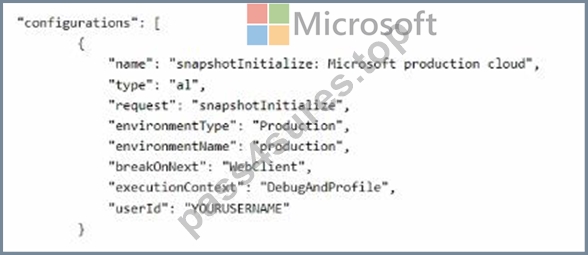
You discover that the debugging is not triggering.
Contoso, Ltd. must connect Business Central to the external API provided by the business partner. This will be used for the partner to send the details of new subcontracting orders to fulfill the sales demand, and for receiving the planned release date of each order sent. The integration requirements are as follows:
* The business partner will provide a REST API secured with basic authentication. Credentials to access the API will be shared with Contoso, ltd.
* The API for sending subcontracting orders must be called by sending an authenticated POST request to the given endpoint.
* The API for retrieving the order no. and planned release date of each subcontracting order responds with the following JSON: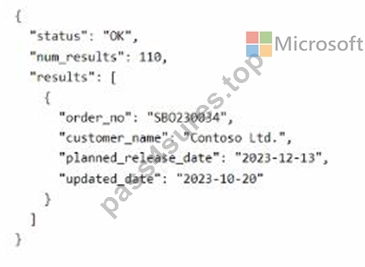
Each order no. must be retrieved.
NEW QUESTION # 24
Hotspot Question
You have the following XML file sample for the Items list: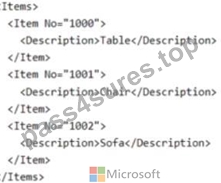
You plan to create the next XML file by using an XMLport object.
You need to complete the code segment to export the file in the required format.
How should you complete the code segment? To answer, select the appropriate options in the answer area.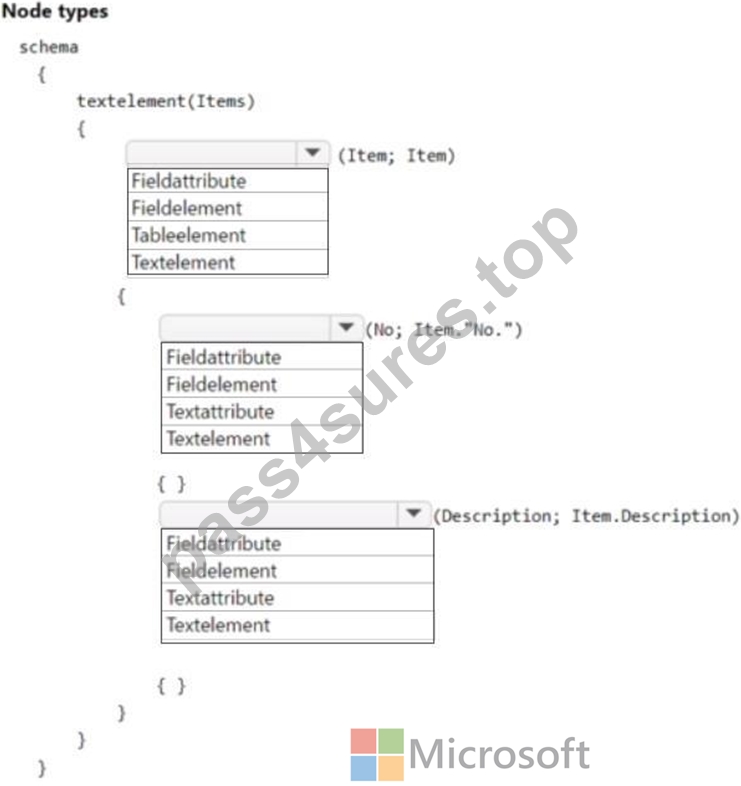
Answer:
Explanation: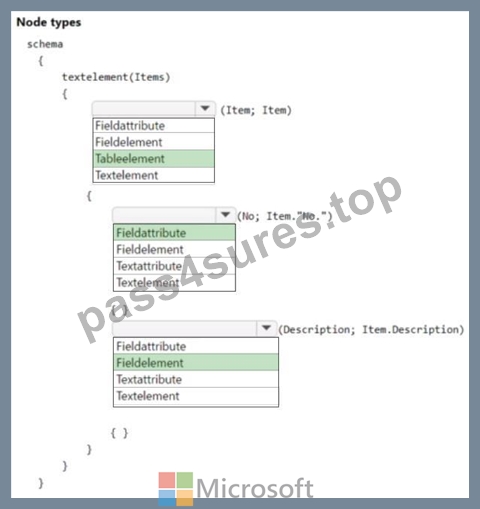
NEW QUESTION # 25
You have the following XML file sample for the Items list: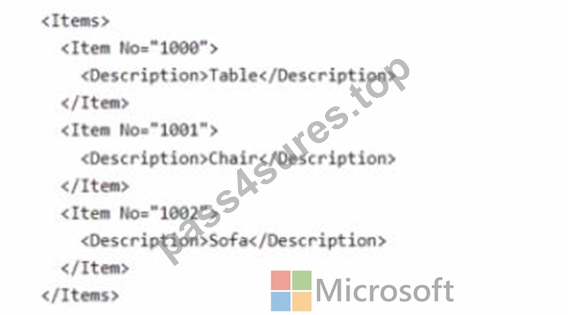
You plan to create the next XML file by using an XMLport object.
You need to complete the code segment to export the file in the required format How should you complete the code segment? To answer, select the appropriate options in the answer area.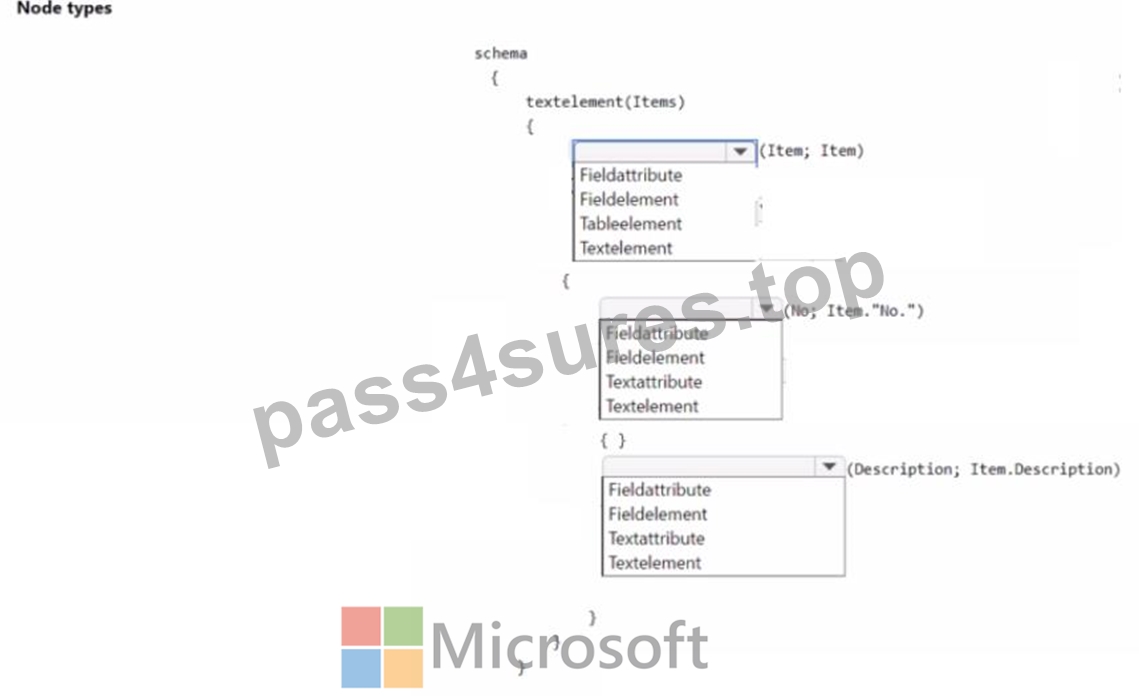
Answer:
Explanation: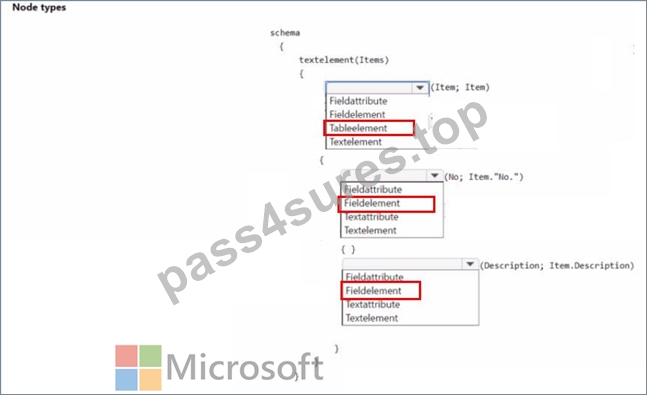
NEW QUESTION # 26
Case Study 2 - Alpine Ski House
Company Background
Alpine Ski House is a company that owns and operates hotels, restaurants, and stores.
Currently, the company uses the following software and interface:
- Property management software (PMS) to manage hotel rooms
- On-premises accounting software to generate sales invoices and create purchase orders
- An API that allows restaurants and stores to obtain necessary information Restaurants and stores use standalone software for point of sale (POS) devices. Each day, the POS terminals generate a text file of sales data and save the files in a server folder. An account assistant must manually import the files to the current software tables to be processed by the system.
The general manager receives several reports monthly from department managers. The reports take too much time to prepare.
Planned improvements
The company is moving from a different system to Business Central online to manage the whole company.
The company plans to increase efficiency in every department by using APIs to obtain or share information between the different systems.
Each department involved in purchasing must be able to make purchase requests automatically and easily. The departments do not need access to the full ERP management system.
Technical specifications
Alpine Ski House requires the development of several extensions for the planned improvements.
Business Central design patterns must be used to develop all extensions.
Alpine Ski House must develop the following pages:
- Pages that provide multiple configurations in a multistep dialog, like a wizard, to provide required information when the extensions are first installed
- Department-specific Role Center pages to show relevant information and pages with additional information The IT department plans to use Power BI to analyze departmental information. The database must be configured to provide optimal performance.
Department-specific requirements
Housekeeping department
The housekeeping department requires the following to increase efficiency and help avoid data entry errors:
- A Housekeeping Role Center to minimize navigation to relevant areas in Business Central online and to show relevant information in it
- Pages to embed into a new Room page to show additional information about the Room entity
- A table named Room Incident for the housekeeping team to enter room issue information
- A Housekeeping canvas app that connects to an extension
- The department requires the development of an extension with a new API page named RoomsAPI.
- The housekeeping team will use RoomsAPI to publish room details, update when work is complete, or provide repair notifications from the canvas app.
- This custom API page must expose a custom table named Rooms and have an ID 50000. The table must be able to update from the PMS. The PMS team must know the endpoint to connect to the custom API.
- A developer provides the following details for the API page: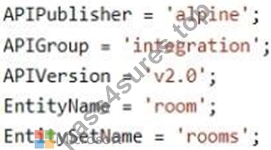
- The extension must be published in Business Central online and include a list page named Room List that includes all hotel rooms.
- Installation or updates to this extension must meet the following requirements:
o Some web services must be published automatically.
o The version of the specified application's metadata must be obtained in AL language, o The code required to perform tasks cannot be accessible from other parts of the application.
The Room Incident table information must include the following fields:
- Incident entry: An incremental number
- Room No.: A room from the Room table
- Incident Date: The work date
o The table definition in the Room Incident table must autofill the Incident Date when the housekeeping team inserts a new record, o The value for Incident Date must be the work date configured in the Business Central online client.
- Status: Includes the following options to identify the status of the incident:
o Open: When the Room Incident is created
o In Progress: When someone starts repair work
o Closed: When the incident is solved
- Incident Closing Date: Auto-updating field (when the status passes to Closed, the field will update with the work date)
- Incident Description: Text
- Image: Media data type
o The stored picture must be downloadable from a menu action,
o A Room Incident page must be developed to contain the download action.
Department-specific requirements
Restaurants and stores
- To increase efficiency, the new system must manage the generated data from the restaurants and stores directly by using the API on the POS terminals.
- The company requires a codeunit called from a job queue to read the information from the POS terminal APIs.
- The POS terminal information must be stored in a table named POS Information, have an ID
50100, and be editable on a page.
- The account manager requires an option on the menu of the page to run the process manually.
- To analyze the information received from the POS terminals, the company requires:
- A custom API named ticketAPI to export the information to Power BI
- Use of the Read Scale-Out feature to improve database performance
Department-specific requirements
Purchasing department and non-conformity handling
The purchasing department requires a new entity in Business Central online to log non- conformities of goods received from vendors. The entity must be set up as follows:
- The non-conformity entity must have two tables:
o a header with common information
o one or more lines with the detailed received items that are non-conforming
- The entity requires a page named Non-conformity and a subpage named Non-conformity Lines to store the information.
When a purchase order with incorrect quantity or quality issues is received, the entity must create a non-conformity document in the system. The following information must be included in the document:
o Non-conformity Number: must use the No. Series table from Business Central online to manage this field and use these features:
o Alphanumeric values
o Number format that includes "NC" and the year as part of the number; for example, NC24-001
- Non-conformity Date: stores only the creation date
- Vendor No.: stores the number of the vendor that sent the items; only vendors from the company must be included
- Owner: code of an employee defined in the company
- Receipt No.: must meet the following conditions:
o Be an existing receipt No.
o Be received from the vendor indicated in the Vendor No. field
- Comments: can include comments with rich text and pictures to illustrate quality problems
- Status: includes non-conformity statuses, such as:
o Open
o Notified
o Closed
- Lines must contain the following details:
o Item No.: item received (for existing inventory items only)
o Description: item description
o Quantity: non-conforming quantity
- Non-conformity Type:
o Quality
o Quantity
o Delivery date
The serial numbers of the non-conformities and the period in which they can be created must be in a configuration table and its corresponding page to allow them to be modified for the users.
Hotspot Question
You need to select the appropriate page types to solve the reporting requirements.
Which page types should you use? To answer, select the appropriate options in the answer area.
NOTE: Each correct selection is worth one point.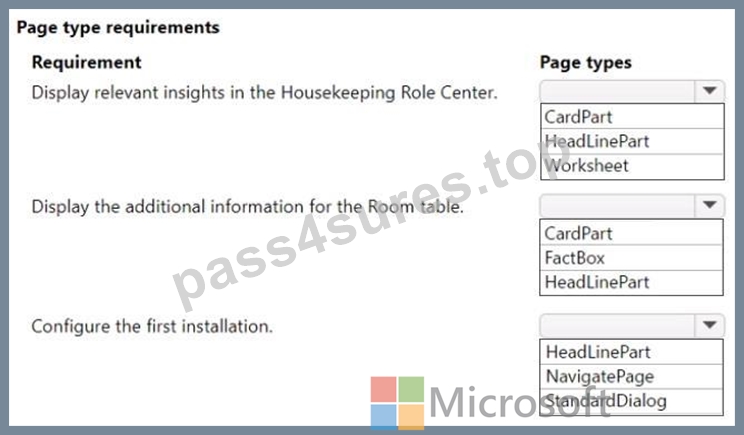
Answer:
Explanation: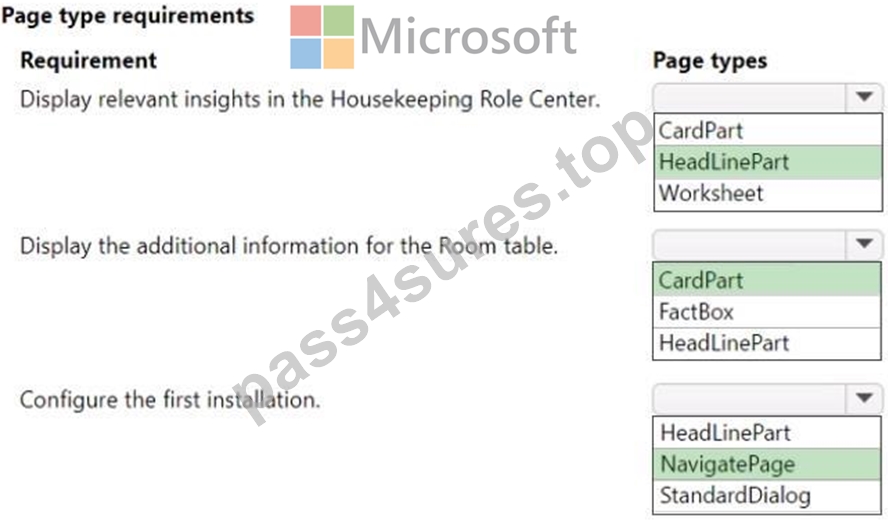
NEW QUESTION # 27
You need to download a stored picture from the Room Incident page.
How should you complete the code segment? To answer, select the appropriate options in the answer area.
NOTE: Each correct selection is worth one point.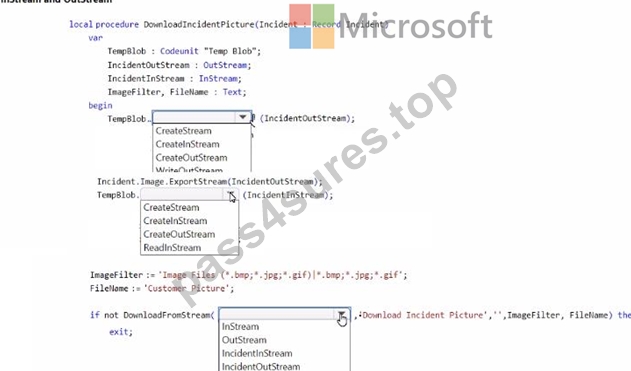
Answer:
Explanation: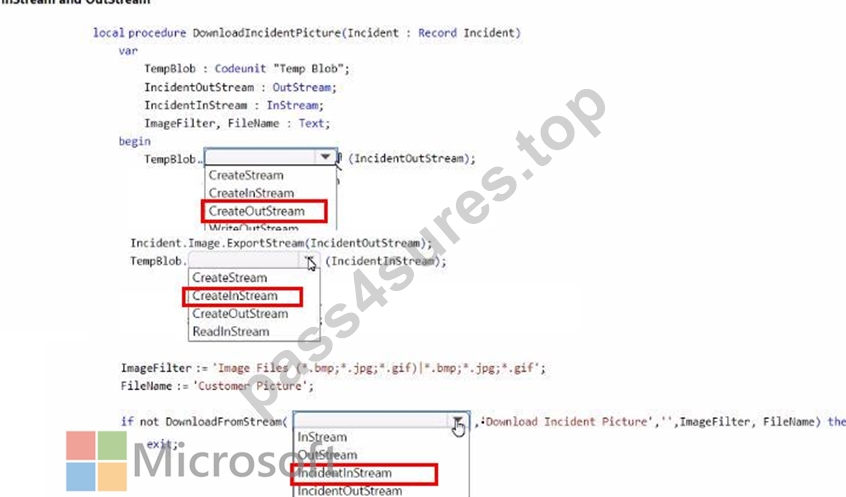
NEW QUESTION # 28
You are developing an app.
You plan to publish the app to Microsoft AppSource.
You need to assign an object range for the app.
Which object range should you use?
- A. divided by countries and use specific a country within the range 100000 to 999999
- B. an object range within the range of 7000000 to 74999999 that is requested from Microsoft
- C. free object within the standard range 1 to 49999
- D. custom object within the range 50000 to 99999
- E. custom object within the range 50000 to 59999
Answer: B
Explanation:
When developing an app for Microsoft AppSource, it is essential to use an object range that is specifically designated by Microsoft to avoid conflicts with other apps and the base application. The correct object range to use is:
An object range within the range of 70000000 to 74999999 that is requested from Microsoft (D): This range is reserved for AppSource apps. Developers need to request this range from Microsoft to ensure that the objects used in their extension do not conflict with those used by other extensions or by the base application. Using this reserved range helps maintain the integrity and compatibility of extensions published on AppSource.
It's important to note that the other ranges mentioned (A, B, C, and E) are not suitable for apps intended for AppSource. Ranges 50000 to 59999 and 50000 to 99999 are typically reserved for per-tenant customizations or partner solutions, not for distribution on AppSource. The standard range 1 to 49999 is reserved for the base application objects, and using an object range divided by countries (C) is not a standard practice for AppSource apps.
NEW QUESTION # 29
Case Study 2 - Alpine Ski House
Company Background
Alpine Ski House is a company that owns and operates hotels, restaurants, and stores.
Currently, the company uses the following software and interface:
- Property management software (PMS) to manage hotel rooms
- On-premises accounting software to generate sales invoices and create purchase orders
- An API that allows restaurants and stores to obtain necessary information Restaurants and stores use standalone software for point of sale (POS) devices. Each day, the POS terminals generate a text file of sales data and save the files in a server folder. An account assistant must manually import the files to the current software tables to be processed by the system.
The general manager receives several reports monthly from department managers. The reports take too much time to prepare.
Planned improvements
The company is moving from a different system to Business Central online to manage the whole company.
The company plans to increase efficiency in every department by using APIs to obtain or share information between the different systems.
Each department involved in purchasing must be able to make purchase requests automatically and easily. The departments do not need access to the full ERP management system.
Technical specifications
Alpine Ski House requires the development of several extensions for the planned improvements.
Business Central design patterns must be used to develop all extensions.
Alpine Ski House must develop the following pages:
- Pages that provide multiple configurations in a multistep dialog, like a wizard, to provide required information when the extensions are first installed
- Department-specific Role Center pages to show relevant information and pages with additional information The IT department plans to use Power BI to analyze departmental information. The database must be configured to provide optimal performance.
Department-specific requirements
Housekeeping department
The housekeeping department requires the following to increase efficiency and help avoid data entry errors:
- A Housekeeping Role Center to minimize navigation to relevant areas in Business Central online and to show relevant information in it
- Pages to embed into a new Room page to show additional information about the Room entity
- A table named Room Incident for the housekeeping team to enter room issue information
- A Housekeeping canvas app that connects to an extension
- The department requires the development of an extension with a new API page named RoomsAPI.
- The housekeeping team will use RoomsAPI to publish room details, update when work is complete, or provide repair notifications from the canvas app.
- This custom API page must expose a custom table named Rooms and have an ID 50000. The table must be able to update from the PMS. The PMS team must know the endpoint to connect to the custom API.
- A developer provides the following details for the API page:
- The extension must be published in Business Central online and include a list page named Room List that includes all hotel rooms.
- Installation or updates to this extension must meet the following requirements:
o Some web services must be published automatically.
o The version of the specified application's metadata must be obtained in AL language, o The code required to perform tasks cannot be accessible from other parts of the application.
The Room Incident table information must include the following fields:
- Incident entry: An incremental number
- Room No.: A room from the Room table
- Incident Date: The work date
o The table definition in the Room Incident table must autofill the Incident Date when the housekeeping team inserts a new record, o The value for Incident Date must be the work date configured in the Business Central online client.
- Status: Includes the following options to identify the status of the incident:
o Open: When the Room Incident is created
o In Progress: When someone starts repair work
o Closed: When the incident is solved
- Incident Closing Date: Auto-updating field (when the status passes to Closed, the field will update with the work date)
- Incident Description: Text
- Image: Media data type
o The stored picture must be downloadable from a menu action,
o A Room Incident page must be developed to contain the download action.
Department-specific requirements
Restaurants and stores
- To increase efficiency, the new system must manage the generated data from the restaurants and stores directly by using the API on the POS terminals.
- The company requires a codeunit called from a job queue to read the information from the POS terminal APIs.
- The POS terminal information must be stored in a table named POS Information, have an ID
50100, and be editable on a page.
- The account manager requires an option on the menu of the page to run the process manually.
- To analyze the information received from the POS terminals, the company requires:
- A custom API named ticketAPI to export the information to Power BI
- Use of the Read Scale-Out feature to improve database performance
Department-specific requirements
Purchasing department and non-conformity handling
The purchasing department requires a new entity in Business Central online to log non- conformities of goods received from vendors. The entity must be set up as follows:
- The non-conformity entity must have two tables:
o a header with common information
o one or more lines with the detailed received items that are non-conforming
- The entity requires a page named Non-conformity and a subpage named Non-conformity Lines to store the information.
When a purchase order with incorrect quantity or quality issues is received, the entity must create a non-conformity document in the system. The following information must be included in the document:
o Non-conformity Number: must use the No. Series table from Business Central online to manage this field and use these features:
o Alphanumeric values
o Number format that includes "NC" and the year as part of the number; for example, NC24-001
- Non-conformity Date: stores only the creation date
- Vendor No.: stores the number of the vendor that sent the items; only vendors from the company must be included
- Owner: code of an employee defined in the company
- Receipt No.: must meet the following conditions:
o Be an existing receipt No.
o Be received from the vendor indicated in the Vendor No. field
- Comments: can include comments with rich text and pictures to illustrate quality problems
- Status: includes non-conformity statuses, such as:
o Open
o Notified
o Closed
- Lines must contain the following details:
o Item No.: item received (for existing inventory items only)
o Description: item description
o Quantity: non-conforming quantity
- Non-conformity Type:
o Quality
o Quantity
o Delivery date
The serial numbers of the non-conformities and the period in which they can be created must be in a configuration table and its corresponding page to allow them to be modified for the users.
You need to define the data types for the fields of the Non-conformity table.
Which two data types should you use? Each correct answer presents part of the solution.
NOTE: Each correct selection is worth one point.
- A. DateTime for the Non-conformity Date field
- B. Date for the Non-conformity Date field
- C. Integer for the Non-conformity Number field
- D. Code for the Non-conformity Number field
- E. Char for the Non-conformity Number field
Answer: B,D
Explanation:
If you are using the standard No. Series you need to use a Code[20] on the field.
NEW QUESTION # 30
A company has the following custom permission set: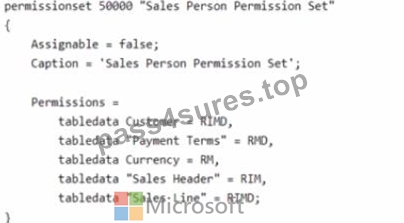
You need to make the permission set visible on the Permission Sets page.
Which three actions should you perform in sequence? To answer, move the appropriate actions from the list of actions to the answer area and arrange them in the correct order.
NOTE: More than one order of answer choices is correct. You will receive credit for any of the correct orders you select.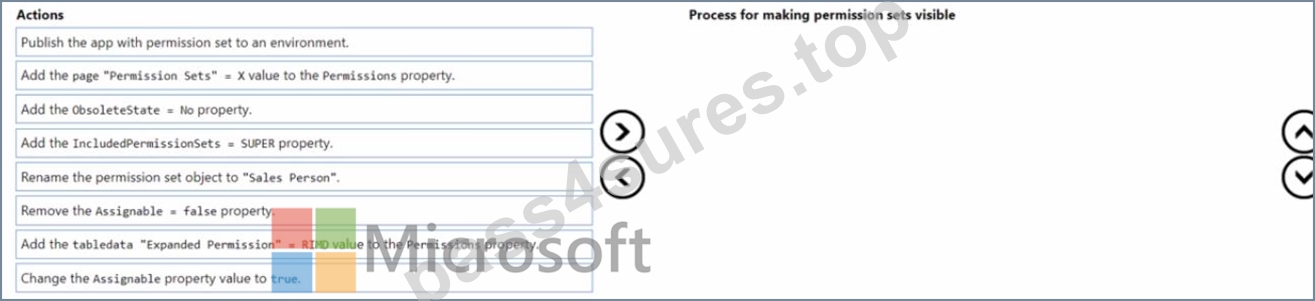
Answer:
Explanation: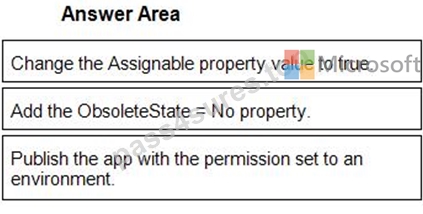
1 - Change the Assignable property value to true.
2 - Add the ObsoleteState = No property.
3 - Publish the app with the permission set to an environment.
Topic 2, Alpine Ski House
Overview
Alpine Ski House is a company that owns and operates hotels, restaurants, and stores. Currently, the company uses the following software and interlace:
* Property management software (PMS) to manage hotel rooms
* On-premises accounting software to generate sales invoices and create purchase orders
* An API that allows restaurants and stores to obtain necessary information Restaurants and stores use standalone software for point of sale (POS) devices. Each day, the POS terminals generate a text file of sales data and save the files in a serval folder. An account assistant must manually import the files to the current software tables to be processed by the system.
The general manager receives several reports monthly from department managers. The reports take too much time to prepare.
The company is moving from a different system to 8usiness Central online to manage the whole company.
The company plans to increase efficiency in every department by using APIs to obtain or share information between the different systems.
Each department involved in purchasing must be able to make purchase requests automatically and easily. The departments do not need access to the full ERP management system.
Alpine Ski House requires the development of several extensions for the planned improvements. Business Central design patterns must be used to develop all extensions.
Alpine Ski House must develop the following pages:
* Pages that provide multiple configurations in a multistep dialog, like a wizard, to provide required information when the extensions are first installed
* Department-specific Role Center pages to show relevant information and pages with additional information The IT department plans to use Power 61 to analyze departmental information. The database must be configured to provide optimal performance.
The housekeeping department requires the following to increase efficiency and help avoid data entry errors:
* A Housekeeping Role Center to minimize navigation to relevant areas In Business Central online and to show relevant information in it
* Pages to embed into a new Room page to show additional information about the Room entity
* A table named Room Incident for the housekeeping team to enter room issue information
* A Housekeeping canvas app that connects to an extension
The department requires the development of an extension with a new API page named RoomsAPI.
* The housekeeping team will use RoomsAPI to publish room details, update when work is complete, or provide repair notifications from the canvas app.
* This custom API page must expose a custom table named Rooms and have an ID 50000. The table must be able to update from the PMS. The PMS team must know the end to connect to the custom API.
* A developer provides the following details for the API page:
APIPublisher = 'alpine';
APIGroup - 'integration';
APIVersion - 'v2.6';
fntityName 'room';
EntitySetName = 'rooms';
* The extension must be published in Business Central online and include a list page named Room List that includes all hotel rooms.
* Installation or updates to this extension must meet the following requirements:
o Some web services must be published automatically.
o The version of the specified application's metadata must be obtained in AL language.
o The code required to perform tasks cannot be accessible from other parts of the application.
The Room Incident table information must include the following fields:
* Incident entry: An incremental number
* Room No.: A room from the Room table
* Incident Date: The work date
o The table definition in the Room Incident table must autofill the Incident Date when the housekeeping team inserts a new record, o The value for Incident Date must be the work date configured in the Business Central online client.
* Status: Includes the following options lo identify the status of the incident:
o Open: When the Room Incident is created
o In Progress: When someone starts repair work
o Closed: When the incident is solved
* Incident Closing Date: Auto-updating field (when the status passes to Closed, the field will update with the work date)
* Incident Description: Text
* Image. Media data type
o The stored picture must be downloadable from a menu action.
o A Room Incident page must be developed to contain the download action.
To increase efficiency, the new system must manage the generated data from the restaurants and stores directly by using the API on the POS terminals.
* The company requires a code unit called from a job queue to read the information from the POS terminal APIs.
* The POS terminal information must be stored in a table named POS Information, have an ID 50100. and be editable on a page.
* The account manager requires an option on the menu of the page to run the process manually.
To analyze the information received from the POS terminals, the company requires:
* A custom API named ticketAPI to export the information to Power BI
* Use of the Read Scale-Out feature to improve database performance
The purchasing department requites a new entity in Business Central online to log non-conformities of goods received from vendors. The entity must be set up as follows:
* The non-conformity entity must have two tables:
o a header with common information
o one or more lines with the detailed received items that are non-conforming
* The entity requires a page named Non-conformity and a subpage named Non-Conformity Lines to store the information.
When a purchase order with incorrect quantity 01 quality issues is received, the entity must create a non-conformity document in the system. The following information must be nick the document:
* Non-conformity Number: must use the No. Series table from Business Central online to manage this field and use these features:
o Alphanumeric values
o Number format that includes "NO and the year as part of the number: for example, NC24-001
* Non-conformity Date: stores only the creation date
* Vendor No.: stores the number of the vendor that sent the items; only vendors from the company must be included
* Owner: code of an employee defined in the company
* Receipt No.: must meet the following conditions:
o Be an existing receipt No.
o Be received from the vendor indicated in the Vendor No. field
* Comments: can include comments with rich text and pictures to illustrate quality problems
* Status: includes nonconformity statuses, such as:
o Open
o Notified
o Closed
* Lines must contain the following details:
o Item No.: item received (for existing inventory items only)
o Description: item description
0 Quantity: non-conforming quantity
0 Non-conformity Type:
* Quality
* Quantity
* Delivery date
The serial numbers of the non-conformities and the period in which they can be created must be in a configuration table and its corresponding page to allow them to be modified for the users.
NEW QUESTION # 31
......
Ultimate Guide to the MB-820 - Latest Edition Available Now: https://prep4tests.pass4sures.top/Microsoft-Dynamics-365/MB-820-testking-braindumps.html