

AZ-303 Practice Exam Tests Latest Updated on Oct-2022
Pass AZ-303 Exam in First Attempt Guaranteed Dumps!
Microsoft AZ-303: Exam Details
The Microsoft AZ-303 exam evaluates your skills in implementing security and management solutions as well as monitoring and implementing Azure infrastructures, among others. The applicants can take it in English, Simplified Chinese, Korean, or Japanese. The number of questions administered in this test is between 40 and 60. The types of questions are multiple choice, case studies, drag and drop, active screen, build list, best answer, short answer, and others. The passing score is 700 points on a scale of 100-1000. To schedule it, you must go through the official exam administrator’s website, which is Pearson VUE. You also have to pay the fee of $165.
AZ-303: Microsoft Azure Architect Technologies Exam Prep Materials
The AZ-303: Developing Solutions for Microsoft Azure exam features a mixture of design and implementation topics. You must be aware of the concepts and technical details involved and understand how they work in the real world. Objectives of Azure certification are aligned with the current trends in Digital Transformation. Premium AZ-303: Developing Solutions for Microsoft Azure exam preparation material is the best way to get certified. Guest blog writers from AZ-303: Microsoft Azure Architect Technologies Exam experts will offer you the best exam preparation materials to help you pass the exam. Reset your brain and learn from the best AZ-303: Developing Solutions for Microsoft Azure exam preparation material. Bastion has collected the best materials for you. Microsoft AZ-303 exam dumps is the best exam preparation material. Single most reliable resource to prepare for the AZ-303: Developing Solutions for Microsoft Azure exam. Proficiency in the relevant technologies along with the specific expertise that this course covers will go a long way in helping you score highly on your AZ-303: Developing Solutions for Microsoft Azure exam.
Query for AZ-303: Microsoft Azure Architect Technologies Exam certification. Easily access exam preparation material from the AZ-303: Microsoft Azure Architect Technologies Exam certification page. Event though the preparation material is sold at a relatively high cost, it can help you get success in your AZ-303: Microsoft Azure Architect Technologies Exam. Introduction to Azure architecture. Formula 1 Az-303: Developing Solutions for Microsoft Azure exam preparation material is the best source to prepare for the exam.
NEW QUESTION 43
You have an Azure Kubernetes Service (AKS) cluster named Clus1 in a resource group named RG1.
An administrator plans to manage Clus1 from an Azure AD-joined device.
You need to ensure that the administrator can deploy the YAML application manifest file for a container application.
You install the Azure CLI on the device.
Which command should you run next?
- A. az aks install-cli
- B. kubectl apply -f app1.yaml
- C. az aks get-credentials --resource-group RG1 --name Clus1
- D. kubectl get nodes
Answer: B
Explanation:
Explanation
kubectl apply -f appl.yaml applies a configuration change to a resource from a file or stdin.
References:
https://kubernetes.io/docs/reference/kubectl/overview/
https://docs.microsoft.com/en-us/cli/azure/aks
NEW QUESTION 44
You need to recommend a solution for App1. The solution must meet the technical requirements. What should you include in the recommendation? To answer, select the appropriate options in the answer area.
NOTE: Each correct selection is worth one point.
Answer:
Explanation:
Explanation:
Box 1: 3
One virtual network for every tier
Box 2: 1
Only one subnet for each tier, to minimize the number of open ports.
Scenario: You have a public-facing application named App1. App1 is comprised of the following three tiers:
A SQL database
A web front end
A processing middle tier
Each tier is comprised of five virtual machines. Users access the web front end by using HTTPS only.
Technical requirements:
Move all the virtual machines for App1 to Azure.
Minimize the number of open ports between the App1 tiers.
NEW QUESTION 45
You have an on-premises virtual machine named VM1 configured as shown in the following exhibit.
VM is started.
You need to create a new virtual machine image in Azure from VM1.
Which three actions should you perform before you create the new image? Each correct answer presents part of the solution.
NOTE: Each correct selection is worth one point.
- A. Run Add-AzureRmVhdand specify a file share as the destination
- B. Reduce the amount of memory to 16 GB
- C. Run Add-AzureRmVhdand specify a blob service container as the destination
- D. Generalize VM1
- E. Remove the Backup (volume shadow copy) integration service
- F. Convert the disk type to VHD
Answer: C,D,F
Explanation:
Section: [none]
Explanation:
B: Sysprep removes all your personal account and security information, and then prepares the machine to be used as an image.
C, F: The Add-AzureRmVhd cmdlet uploads on-premises virtual hard disks, in .vhd file format, to a blob storage account as fixed virtual hard disks.
References:
https://docs.microsoft.com/en-us/powershell/module/azurerm.compute/add-azurermvhd?view=azurermps-
6.13.0
https://docs.microsoft.com/en-us/azure/virtual-machines/windows/capture-image-resource
NEW QUESTION 46
Note: This question is part of series of questions that present the same scenario. Each question in the series contains a unique solution that might meet the stated goals. Some question sets might have more than one correct solution, while others might not have a correct solution.
After you answer a question in this section, you will NOT be able to return to it. As a result, these questions will not appear in the review screen.
You are planning to create a virtual network that has a scale set that contains six virtual machines (VMs).
A monitoring solution on a different network will need access to the VMs inside the scale set.
You need to define public access to the VMs.
Solution: Use Remote Desktop Protocol (RDP) to connect to the VM in the scale set.
Does the solution meet the goal?
- A. No
- B. Yes
Answer: B
Explanation:
Section: [none]
Explanation:
Instead, deploy a standalone VM that has a public IP address to the virtual network.
NEW QUESTION 47
Your network contains an on-premises Active Directory domain named contoso.com that contains a user named User1. The domain syncs to Azure Active Directory (Azure AD). You have the Windows 10 devices shown in the following table.
The User Sign-In settings are configured as shown in the following exhibit.

For each of the following statements, select Yes if the statement is true. Otherwise, select No. NOTE: Each correct selection is worth one point
Answer:
Explanation:
Explanation
Box 1: Yes
Seamless SSO needs the user's device to be domain-joined only, but it is not used on Azure AD Joined or Hybrid Azure AD joined devices. SSO on Azure AD joined, Hybrid Azure AD joined, and Azure AD registered devices works based on the primary refresh token.
Box 2: No
Box 3: No
Reference:
https://docs.microsoft.com/en-us/azure/active-directory/hybrid/how-to-connect-sso
NEW QUESTION 48
You create a container image named Image1 on a developer workstation.
You plan to create an Azure Web App for Containers named WebAppContainer that will use Image1.
You need to upload Image1 to Azure. The solution must ensure that WebAppContainer can use Image1.
To which storage type should you upload Image1?
- A. Azure Container Registry
- B. an Azure Storage account that contains a blob container
- C. Azure Container Instances
- D. an Azure Storage account that contains a file share
Answer: A
Explanation:
Configure registry credentials in web app.
App Service needs information about your registry and image to pull the private image. In the Azure portal, go to Container settings from the web app and update the Image source, Registry and save.
Reference:
https://docs.microsoft.com/en-us/azure/devops/pipelines/targets/webapp-on-container-linux
NEW QUESTION 49
A company runs multiple Windows virtual machines (VMs) in Azure.
The IT operations department wants to apply the same policies as they have for on-premises VMs to the VMs running in Azure, including domain administrator permissions and schema extensions.
You need to recommend a solution for the hybrid scenario that minimizes the amount of maintenance required.
What should you recommend? To answer, select the appropriate options in the answer area.
NOTE: Each correct selection is worth one point.
Answer:
Explanation:
Explanation:
Box 1: Join the VMs to a new domain controller VM in Azure
Azure provides two solutions for implementing directory and identity services in Azure:
* (Used in this scenario) Extend your existing on-premises Active Directory infrastructure to Azure, by deploying a VM in Azure that runs AD DS as a Domain Controller. This architecture is more common when the on-premises network and the Azure virtual network (VNet) are connected by a VPN or ExpressRoute connection.
* Use Azure AD to create an Active Directory domain in the cloud and connect it to your on-premises Active Directory domain. Azure AD Connect integrates your on-premises directories with Azure AD.
Box 2: Set up VPN connectivity.
This architecture is more common when the on-premises network and the Azure virtual network (VNet) are connected by a VPN or ExpressRoute connection.
References:
https://docs.microsoft.com/en-us/azure/architecture/reference-architectures/identity/
NEW QUESTION 50
DRAG DROP
You have an Azure virtual machine named VM1 that runs Windows Server 2016.
You install a line-of-business application on VM1.
You need to create a scale set by using VM1 as a custom image.
Which three actions should you perform in sequence? To answer, move the appropriate actions from the list of actions to the answer area and arrange them in the correct order.
Select and Place:
Answer:
Explanation:
Section: [none]
Explanation:
Step 1: Run sysprep.exe on VM1.
The final step to prepare your VM for use as a custom image is to generalize the VM. Sysprep removes all your personal account information and configurations, and resets the VM to a clean state for future deployments.
Step 2: From Azure CLI, deallocate VM1 and mark VM1 as generalized,
To create an image, the VM needs to be deallocated. Deallocate the VM with Stop-AzVm. Then, set the state of the VM as generalized with Set-AzVm so that the Azure platform knows the VM is ready for use a custom image. You can only create an image from a generalized VM.
It may take a few minutes to deallocate and generalize the VM.
Then create an image of the VM with New-AzImageConfig and New-AzImage.
Step 3: Create a virtual machine scale set.
Create a scale set with New-AzVmss that uses the -ImageName parameter to define the custom VM image created in the previous step.
References:
https://docs.microsoft.com/en-us/azure/virtual-machine-scale-sets/tutorial-use-custom-image-powershell
NEW QUESTION 51
DRAG DROP
You have an on-premises file server named Server1 that runs Windows Server 2016.
You have an Azure subscription that contains an Azure file share.
You deploy an Azure File Sync Storage Sync Service, and you create a sync group.
You need to synchronize files from Server1 to Azure.
Which three actions should you perform in sequence? To answer, move the appropriate actions from the list of actions to the answer area and arrange them in the correct order.
Select and Place:
Answer:
Explanation:
Section: [none]
Explanation:
Step 1: Install the Azure File Sync agent on Server1
The Azure File Sync agent is a downloadable package that enables Windows Server to be synced with an Azure file share Step 2: Register Server1.
Register Windows Server with Storage Sync Service
Registering your Windows Server with a Storage Sync Service establishes a trust relationship between your server (or cluster) and the Storage Sync Service.
Step 3: Add a server endpoint
Create a sync group and a cloud endpoint.
A sync group defines the sync topology for a set of files. Endpoints within a sync group are kept in sync with each other. A sync group must contain one cloud endpoint, which represents an Azure file share and one or more server endpoints. A server endpoint represents a path on registered server.
References:
https://docs.microsoft.com/en-us/azure/storage/files/storage-sync-files-deployment-guide
NEW QUESTION 52
Your network contains an on-premises Active Directory and an Azure Active Directory (Azure AD) tenant.
You deploy Azure AD Connect and configure pass-through authentication.
Your Azure subscription contains several web apps that are accessed from the Internet.
You plan to use Azure Multi-Factor Authentication (MFA) with the Azure Active Directory tenant.
You need to recommend a solution to prevent users from being prompted for Azure MFA when they access the web apps from the on-premises network.
What should you include in the recommendation?
- A. an Azure ExpressRoute circuit
- B. an Azure policy
- C. trusted IPs
- D. a site-to-site VPN between the on-premises network and Azure
Answer: C
Explanation:
Section: [none]
Explanation:
The Trusted IPs feature of Azure Multi-Factor Authentication is used by administrators of a managed or federated tenant. The feature bypasses two-step verification for users who sign in from the company intranet.
The feature is available with the full version of Azure Multi-Factor Authentication, and not the free version for administrators.
Reference:
https://docs.microsoft.com/en-us/azure/active-directory/authentication/howto-mfa-mfasettings#trusted-ips
NEW QUESTION 53
You are developing an app that references data which is sharded across multiple Azure SQL databases.
The app must guarantee transactional consistency for changes across several different sharding key values.
You need to manage the transactions.
What should you implement?
- A. Elastic database transactions with vertical partitioning.
- B. Server-coordinated transactions from .NET application.
- C. Distributed transactions coordinated by Microsoft Distributed Transaction Coordinator (MSDTC).
- D. Elastic database transactions with horizontal partitioning.
Answer: D
Explanation:
Explanation/Reference:
References:
https://docs.microsoft.com/mt-mt/azure/sql-database/sql-database-elastic-transactions-overview?
view=azurermps-6.13.0
NEW QUESTION 54
You create a container image named Image1 on a developer workstation.
You plan to create an Azure Web App for Containers named WebAppContainer that will use Image1.
You need to upload Image1 to Azure. The solution must ensure that WebAppContainer can use Image1.
To which storage type should you upload Image1?
- A. Azure Container Registry
- B. an Azure Storage account that contains a blob container
- C. Azure Container Instances
- D. an Azure Storage account that contains a file share
Answer: A
Explanation:
Section: [none]
Explanation:
Configure registry credentials in web app.
App Service needs information about your registry and image to pull the private image. In the Azure portal, go to Container settings from the web app and update the Image source, Registry and save.
Reference:
https://docs.microsoft.com/en-us/azure/devops/pipelines/targets/webapp-on-container-linux
NEW QUESTION 55
You have an Azure subscription.
You plan to deploy an app that has a web front end and an application tier.
You need to recommend a load balancing solution that meets the following requirements:
Internet to web tier:
- Provides URL-based routing
- Supports connection draining
- Prevents SQL injection attacks
Web tier to application tier:
- Provides port forwarding
- Supports HTTPS health probes
- Supports an availability set as a backend pool
Which load balancing solution should you recommend for each tier? To answer, select the appropriate options in the answer area.
NOTE: Each correct selection is worth one point.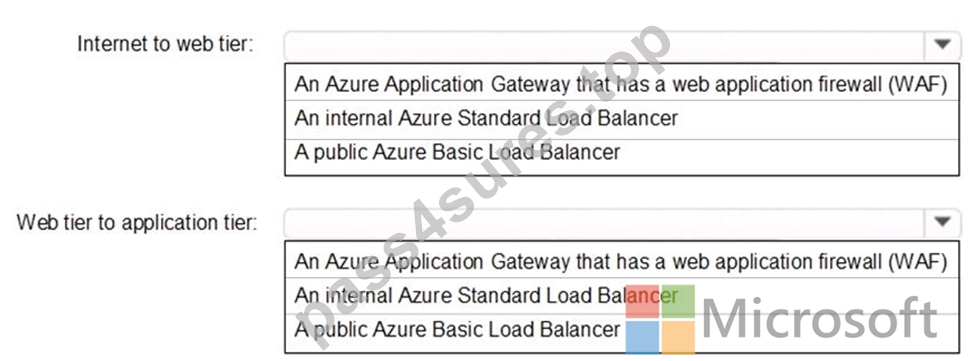
Answer:
Explanation:
Explanation:
Box 1: An Azure Application Gateway that has a web application firewall (WAF) Azure Application Gateway offers a web application firewall (WAF) that provides centralized protection of your web applications from common exploits and vulnerabilities. Web applications are increasingly targeted by malicious attacks that exploit commonly known vulnerabilities. SQL injection and cross-site scripting are among the most common attacks.
Application Gateway operates as an application delivery controller (ADC). It offers Secure Sockets Layer (SSL) termination, cookie-based session affinity, round-robin load distribution, content-based routing, ability to host multiple websites, and security enhancements.
Box 2: An internal Azure Standard Load Balancer
The internet to web tier is the public interface, while the web tier to application tier should be internal.
Note: When using load-balancing rules with Azure Load Balancer, you need to specify a health probes to allow Load Balancer to detect the backend endpoint status.
Health probes support the TCP, HTTP, HTTPS protocols.
References:
https://docs.microsoft.com/en-us/azure/application-gateway/waf-overview
https://docs.microsoft.com/en-us/azure/load-balancer/load-balancer-custom-probe-overview
NEW QUESTION 56
HOTSPOT
A company runs multiple Windows virtual machines (VMs) in Azure.
The IT operations department wants to apply the same policies as they have for on-premises VMs to the VMs running in Azure, including domain administrator permissions and schema extensions.
You need to recommend a solution for the hybrid scenario that minimizes the amount of maintenance required.
What should you recommend? To answer, select the appropriate options in the answer area.
NOTE: Each correct selection is worth one point.
Hot Area:
Answer:
Explanation:
Section: [none]
Explanation:
Box 1: Join the VMs to a new domain controller VM in Azure
Azure provides two solutions for implementing directory and identity services in Azure:
* (Used in this scenario) Extend your existing on-premises Active Directory infrastructure to Azure, by deploying a VM in Azure that runs AD DS as a Domain Controller. This architecture is more common when the on-premises network and the Azure virtual network (VNet) are connected by a VPN or ExpressRoute connection.
* Use Azure AD to create an Active Directory domain in the cloud and connect it to your on-premises Active Directory domain. Azure AD Connect integrates your on-premises directories with Azure AD.
Box 2: Set up VPN connectivity.
This architecture is more common when the on-premises network and the Azure virtual network (VNet) are connected by a VPN or ExpressRoute connection.
References:
https://docs.microsoft.com/en-us/azure/architecture/reference-architectures/identity/
NEW QUESTION 57
You have an Azure subscription.
You plan to deploy an app that has a web front end and an application tier.
You need to recommend a load balancing solution that meets the following requirements:
Internet to web tier:
- Provides URL-based routing
- Supports connection draining
- Prevents SQL injection attacks
Web tier to application tier:
- Provides port forwarding
- Supports HTTPS health probes
- Supports an availability set as a backend pool
Which load balancing solution should you recommend for each tier? To answer, select the appropriate options in the answer area.
NOTE: Each correct selection is worth one point.
Answer:
Explanation:
References:
https://docs.microsoft.com/en-us/azure/application-gateway/waf-overview
https://docs.microsoft.com/en-us/azure/load-balancer/load-balancer-custom-probe-overview
NEW QUESTION 58
You plan to deploy five virtual machines to a virtual network subnet.
Each virtual machine will have a public IP address and a private IP address.
Each virtual machine requires the same inbound and outbound security rules.
What is the minimum number of network interfaces and network security groups that you require? To answer, select the appropriate options in the answer area.
NOTE: Each correct selection is worth one point.
Answer:
Explanation:
Explanation
By Default Inbound and Outbound Security Rules are same for all VMs. Therefore, if default rules suffice, then there is no need for NSG at all. 5 NICs and 1 NSG for non-default Inbound and Outbound Rules 5 Nics and 0 NSG for default Inbound and Outbound Rules.
NEW QUESTION 59
......
Azure Solutions Architect Expert Free Certification Exam Material from Pass4sures with 220 Questions: https://prep4tests.pass4sures.top/Azure-Solutions-Architect-Expert/AZ-303-testking-braindumps.html