

[Nov 12, 2025] Free Lpi 010-160 Exam Questions and Answer
Verified 010-160 dumps Q&As Latest 010-160 Download
The Linux Essentials Certificate Exam is a great starting point for individuals who are interested in pursuing a career in Linux or open-source technology. Linux Essentials Certificate Exam - version 1.6 certification is ideal for students, entry-level professionals, and anyone who wants to have a fundamental understanding of Linux. It is also a great way for IT professionals to expand their knowledge and skillset.
NEW QUESTION # 19
Which of the following commands creates an archive filework.tarfrom the contents of the directory./ work/?
- A. tar work.tar < ./work/
- B. tar work > work.tar
- C. tar -create work.tgz -content ./work/
- D. tar -cf work.tar ./work/
- E. tar --new work.tar ./work/
Answer: D
Explanation:
Explanation
The tar command in Linux is used to create, extract, list, and manipulate archive files1. The -c option tells the command to create a new archive file. The -f option specifies the name of the archive file. The last argument is the name of the directory or file to be archived. Therefore, the command tar -cf work.tar ./work/ will create an archive file named work.tar from the contents of the directory ./work/. The other options are either invalid or do not create the desired archive file. Option A uses an unrecognized option --new. Option C uses an incorrect option --content and an incorrect extension .tgz for a plain tar archive. Option D and E use an incorrect syntax for redirecting the input or output of the tar command. References:
* Linux Essentials Version 1.6 Objectives, Topic 1.4: Command Line Basics, Subtopic: Basic Shell Commands
* Linux Essentials Version 1.6 Exam Preparation Guide, Section 1.4: Command Line Basics, Page 16
* Tar Command in Linux (Create and Extract Archives) | Linuxize2
NEW QUESTION # 20
Which of the following outputs comes from the commandfree?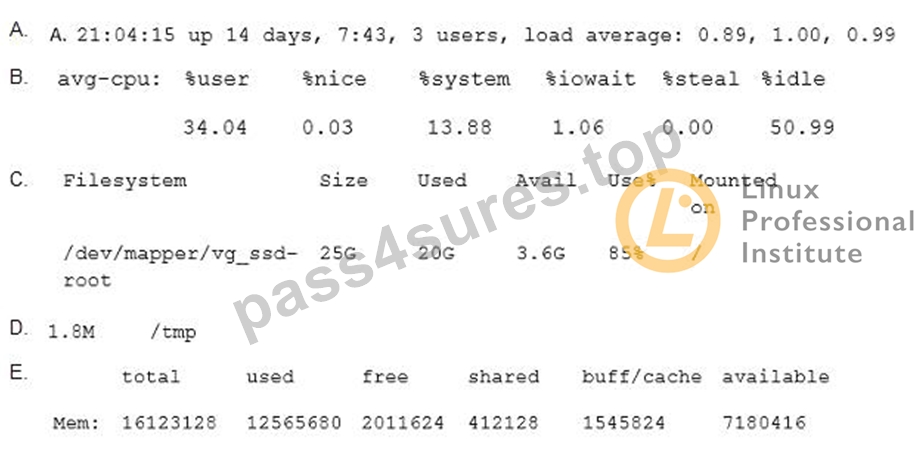
- A. Option B
- B. Option E
- C. Option D
- D. Option C
- E. Option A
Answer: B
NEW QUESTION # 21
Which command displays file names only and no additional information?
- A. ls -nl
- B. ls -lh
- C. ls -a
- D. ls -l
- E. ls -alh
Answer: C
Explanation:
The ls command is used to list the files and directories in a given path. By default, the ls command displays only the file names, without any additional information. However, the ls command can also take various options to modify its output. For example, the -l option tells ls to display the long format, which includes the file permissions, owner, group, size, date, and name. The -h option tells ls to display the file sizes in a human-readable format, such as KB, MB, GB, etc. The -a option tells ls to display all files, including the hidden ones that start with a dot (.). The -n option tells ls to display the numeric user ID and group ID instead of the user name and group name. Therefore, the only option that does not add any additional information to the file names is the -a option. The command ls -a will display all the file names in the current directory, including the hidden ones, but nothing else. Reference:
Linux Essentials - Linux Professional Institute (LPI), section 2.1.1
2.1 Lesson 1 - Linux Professional Institute Certification Programs, slide 6.
NEW QUESTION # 22
Which of the following directories must be mounted with read and write access if it resides on its own dedicated file system?
- A. /opt
- B. /var
- C. /lib
- D. /etc
- E. /usr
Answer: B
Explanation:
The /var directory must be mounted with read and write access if it resides on its own dedicated file system. The reason is that the /var directory contains files and directories that are expected to change in size and content as the normal operation of the system progresses, such as logs, spool files, and temporary files1. Therefore, the /var directory needs to have enough space and permission to accommodate these changes. If the /var directory is mounted as read-only, some system services and applications may fail to start or function properly2.
The other options are not directories that must be mounted with read and write access if they reside on their own dedicated file system. The /opt directory contains optional or third-party software packages that are not part of the default installation1. The /lib directory contains libraries and kernel modules that are essential for the binaries in /bin and /sbin directories1. The /etc directory contains configuration files for the system and applications1. The /usr directory contains user-related programs, libraries, documentation, and data1. These directories are usually mounted as read-only to prevent accidental or malicious modification of their contents3. Reference:
Linux Essentials Exam Objectives, Version 1.6, Topic 102.1, Weight 3
Linux Essentials Certification Guide, Chapter 2, Page 34-35
Linux Filesystem Hierarchy, Chapter 3, Page 17-18
NEW QUESTION # 23
Which command copies the contents of the directory /etc/, including all sub-directories, to /root/?
- A. cp -r /etc/* /root
- B. rcp /etc/* /root
- C. cp -R /etc/*.* /root
- D. copy /etc /root
- E. cp -v /etc/* /root
Answer: A
Explanation:
Explanation
The correct command to copy the contents of the directory /etc/, including all sub-directories, to /root/ is cp -r
/etc/* /root. This command uses the cp command, which stands for copy, and is used to copy files and directories on Linux and Unix systems. The command also uses the following options and arguments123:
* The -r option, which stands for recursive, and tells cp to copy all files and sub-directories of the source directory. Alternatively, the -R option can be used, which has the same effect as -r.
* The /etc/* argument, which specifies the source directory and all its contents. The asterisk (*) is a wildcard character that matches any file or directory name. This argument tells cp to copy everything inside the /etc/ directory, but not the directory itself.
* The /root argument, which specifies the destination directory. This argument tells cp to copy the source files and sub-directories to the /root/ directory.
The other options are incorrect because they use different commands or syntax that do not copy the contents of the directory /etc/, including all sub-directories, to /root/. For example:
* Option A uses the copy command, which is not a valid Linux command. The correct command is cp.
* Option C uses the -v option, which stands for verbose, and tells cp to print verbose output. This option does not affect the copying process, but only the output. It also does not include the -r or -R option, which is necessary to copy the sub-directories.
* Option D uses the rcp command, which stands for remote copy, and is used to copy files between different hosts on a network. This command is not relevant for copying files on the same host.
* Option E uses the -R option, which is correct, but also uses the . argument, which is incorrect. The dot (.) is a special character that matches any single character. This argument tells cp to copy only the files and directories that have a dot in their name, which may exclude some files and directories that do not have a dot.
References: 1: Cp Command in Linux (Copy Files) | Linuxize 2: cp command in Linux with examples - GeeksforGeeks 3: How to Copy Files and Directories in the Linux Terminal
NEW QUESTION # 24
Which files are the source of the information in the following output? (Choose two.) uid=1000 (bob) gid=1000 (bob) groups=1000 (bob), 10 (wheel), 150 (docker), 1001 (libvirt)(wireshark),989
- A. /var/db/users
- B. /etc/group
- C. /home/index
- D. /etc/id
- E. /etc/passwd
Answer: B,E
Explanation:
Explanation
The files /etc/passwd and /etc/group are the source of the information in the following output:
uid=1000 (bob) gid=1000 (bob) groups=1000 (bob), 10 (wheel), 150 (docker), 1001 (libvirt) (wireshark), 989 The /etc/passwd file contains information about user accounts, such as the username, password, user ID (UID), group ID (GID), full name, home directory, and login shell1. The /etc/group file contains information about groups, such as the group name, password, group ID (GID), and members2.
The output shows the UID, GID, and group membership of the user bob. The UID and GID of bob are 1000, which can be found in the /etc/passwd file. The groups that bob belongs to are bob, wheel, docker, libvirt, wireshark, and 989, which can be found in the /etc/group file. The group names are shown in parentheses after the GID, except for the last group, which has no name.
The other options are not files that store user and group information in Linux. The /etc/id file does not exist by default. The /home/index file is not a standard file and has no relation to user and group information. The
/var/db/users file is not a standard file and has no relation to user and group information. References:
* Linux Essentials Exam Objectives, Version 1.6, Topic 103.1, Weight 2
* Linux Essentials Certification Guide, Chapter 3, Page 51-52
* Linux Filesystem Hierarchy, Chapter 3, Page 17-18
* Linux Users and Groups, Chapter 2, Page 9-10
NEW QUESTION # 25
Which of the following statements regarding Linux hardware drivers is correct?
- A. Drivers are stored on their devices and are copied by the Linux kernel when a new device is attached
- B. Drivers are either compiled into the Linux kernel or are loaded as kernel modules.
- C. Drivers are downloaded from the vendor's driver repository when a new device is attached.
- D. Drivers are regular Linux programs which have to be run by the user who wants to use a device.
- E. Drivers are not used by Linux because the BIOS handles all access to hardware on behalf of Linux.
Answer: B
Explanation:
Explanation
Linux hardware drivers are software components that enable the Linux kernel to communicate with various devices, such as keyboards, mice, printers, scanners, network cards, etc. Drivers are either compiled into the Linux kernel or are loaded as kernel modules. Kernel modules are pieces of code that can be loaded and unloaded into the kernelon demand. They extend the functionality of the kernel without requiring to rebuild or reboot the system. Drivers that are compiled into the kernel are always available, but they increase the size and complexity of the kernel. Drivers that are loaded as kernel modules are only available when needed, but they require a matching version of the kernel and the module. Linux supports a large number of hardware devices, thanks to the efforts of the open source community and some vendors who provide drivers for their products.
However, some devices may not have a driver available for Linux, or may require a proprietary driver that is not included in the Linux distribution. In such cases, the user may need to install the driver manually from the vendor's website or from a third-party repository. References:
* Linux Essentials - Linux Professional Institute (LPI), section 2.2.1
* LPI Linux Essentials Study Guide: Exam 010 v1.6, 3rd Edition, chapter 3, page 67.
NEW QUESTION # 26
Running the command rm Downloads leads to the following error:
rm: cannot remove 'Downloads/': Is a directory
Which of the following commands can be used instead to remove Downloads, assuming Downloads is empty? (Choose two correct answers.)
- A. undir Downloads
- B. rm -r Downloads
- C. rem Downloads
- D. rmdir Downloads
- E. dir -r Downloads
Answer: B,D
Explanation:
To remove a directory, you need to use a command that can delete directories, not just files. The rm command can only remove files by default, unless you use the -r option, which stands for recursive. This option tells rm to delete the directory and all of its contents, including subdirectories and files. The rmdir command can also remove directories, but only if they are empty. If the directory contains any files or subdirectories, rmdir will fail and display an error message. Therefore, the correct commands to remove Downloads, assuming it is empty, are rmdir Downloads and rm -r Downloads. The other commands are either invalid or do not work on directories. Reference:
Linux Essentials - Linux Professional Institute (LPI), section 2.3.1
LPI Linux Essentials Study Guide: Exam 010 v1.6, 3rd Edition, chapter 4, page 93.
NEW QUESTION # 27
When typing a long command line at the shell, what single character can be used to split a command across multiple lines?
Answer:
Explanation:
\
Explanation:
The backslash character () is used to escape the meaning of the next character in a command line. This means that the next character is treated as a literal character, not as a special character. For example, if you want to use a space in a file name, you can use a backslash before the space to prevent the shell from interpreting it as a separator. Similarly, if you want to split a long command line across multiple lines, you can use a backslash at the end of each line to tell the shell that the command is not finished yet. The shell will ignore the newline character and continue reading the next line as part of the same command. For example, you can write:
ls -l
/home/user/Documents
instead of:
ls -l /home/user/Documents
Both commands will produce the same output, but the first one is easier to read and type. Reference:
Linux Essentials - Linux Professional Institute (LPI), section 2.1.2
2.1 Command Line Basics - Linux Professional Institute Certification Programs, slide 7.
NEW QUESTION # 28
Which of the following commands finds all lines in the file operating-systems.txt which contain the term linux, regardless of the case?
- A. cut linux operating-systems.txt
- B. igrep linux operating-systems.txt
- C. cut [Ll] [Ii] [Nn] [Uu] [Xx] operating-systems.txt
- D. grep -i linux operating-systems.txt
- E. less -i linux operating-systems.txt
Answer: D
Explanation:
Explanation
The grep command is used to search for a pattern in a file or input. The -i option makes the search case-insensitive, meaning that it will match both uppercase and lowercase letters. The grep command takes the pattern as the first argument and the file name as the second argument. Therefore, the command grep -i linux operating-systems.txt will find all lines in the file operating-systems.txt which contain the term linux, regardless of the case. References: Linux Essentials - Topic 103: Finding Linux Documentation and Linux Essentials - Topic 104: Command Line Basics
NEW QUESTION # 29
Most commands on Linux can display information on their usage. How can this information typically be displayed?
- A. By running the command with the option /doc or /documentation.
- B. By running the command with the option /? or /??.
- C. By running the command with the option ?! or ?=!.
- D. By running the command with the option -m or --manpage.
- E. By running the command with the option -h or --help.
Answer: E
Explanation:
Most commands on Linux can display information on their usage by running the command with the option -h or --help. This option shows a brief summary of the command syntax, options, arguments, and examples. For example, running ls -h or ls --help will display the usage information for the ls command, which lists files and directories. The -h or --help option is a standard convention for most Linux commands, and it is useful for learning how to use a command or checking its available options. However, some commands may not support this option, or may use a different option to display usage information. In that case, you can use the man command to access the manual page for the command, which provides more detailed information on the command usage, description, options, arguments, examples, and references. For example, running man ls will display the manual page for the ls command. The man command is one of the applications covered in the Linux Essentials certification program from the Linux Professional Institute (LPI). Reference:
Linux Essentials - Linux Professional Institute (LPI)
Linux Commands Cheat Sheet: Beginner to Advanced - GeeksforGeeks
NEW QUESTION # 30
Which of the following Linux Distributions is derived from Red Hat Enterprise Linux?
- A. Ubuntu
- B. Debian
- C. CentOS
- D. Raspbian
- E. openSUSE
Answer: C
NEW QUESTION # 31
What happens to a file residing outside the home directory when the file owner's account is deleted? (Choose two.)
- A. The UID of the former owner is shown when listing the file's details.
- B. The file is removed from the file system.
- C. Ownership and permissions of the file remain unchanged.
- D. The user root is set as the new owner of the file.
- E. During a file system check, the file is moved to /lost +found.
Answer: A,C
Explanation:
When a user account is deleted, the files owned by that user are not automatically deleted from the file system, unless they are in the user's home directory. The files residing outside the home directory will remain unchanged, but they will have an invalid owner. The owner of a file is identified by a numeric user ID (UID), which is mapped to a user name by the /etc/passwd file. When a user is deleted, the corresponding entry in the /etc/passwd file is removed, but the UID of the file is not changed. Therefore, when listing the file's details, the UID of the former owner is shown instead of the user name. For example, if the user alice with UID 1001 is deleted, and she owns a file named report.txt in the /tmp directory, the output of ls -l /tmp/report.txt will look something like this:
-rw-r-r-- 1 1001 users 1024 Nov 20 14:11 /tmp/report.txt
The user root is not set as the new owner of the file, nor is the file moved to /lost+found or removed from the file system. The /lost+found directory is used to store files that are recovered from a corrupted file system after running the fsck command, not from deleted user accounts. The file system check does not affect the ownership or permissions of the files, unless there is a serious inconsistency that needs to be fixed. Reference:
Linux Essentials - Linux Professional Institute (LPI), section 5.2.1
5.2 Lesson 1 - Linux Professional Institute Certification Programs, slide 6.
NEW QUESTION # 32
What is true about thedmesgcommand? (Choose two correct answers.)
- A. It sends messages to the command lines of all current user sessions.
- B. It traces the execution of a command and shows each step the program carries out.
- C. It displays the content of the Linux kernel's ring buffer.
- D. It might not display older information because it was overwritten by newer information.
- E. It immediately outputs all new messages written to the system journal.
Answer: C,D
NEW QUESTION # 33
Which of the following types of bus can connect hard disk drives with the motherboard?
- A. The Auto bus
- B. The SATA bus
- C. The RAM bus
- D. The CPU bus
- E. The NUMA bus
Answer: B
Explanation:
Explanation
A bus is a communication system that transfers data between components inside a computer or between computers. There are different types of buses that serve different purposes. The RAM bus connects the CPU with the main memory, the NUMA bus connects multiple processors in a multiprocessor system, the CPU bus connects the CPU with other components on the motherboard, and the Auto bus is a fictional bus that can transform into a robot. The SATA bus is the correct answer because it is a type of bus that can connect hard disk drives with the motherboard. SATA stands for Serial Advanced Technology Attachment and it is a standard interface for connecting storage devices such as hard disk drives, solid state drives, and optical drives.
SATA offers faster data transfer rates, lower power consumption, and improved cable management compared to older interfaces such as IDE and SCSI. References: : [Bus (computing)] : [Transformers: Robots in Disguise (2015 TV series)] : [Serial ATA]3) : [SATA vs. IDE: What's the Difference?]
NEW QUESTION # 34
What is true about links in a Linux file system?
- A. A symbolic link can only point to a file and not to a directory.
- B. A hard link can only point to a directory and never to a file.
- C. A symbolic link can point to a file on another file system.
- D. Only the root user can create hard links.
- E. When the target of the symbolic link is moved, the link is automatically updated.
Answer: C
Explanation:
A symbolic link, also known as a symlink or soft link, is a special type of file that points to another file or directory by its name. A symbolic link can point to a file or directory on the same or different file system, as long as the target is accessible. For example, you can create a symbolic link to a file on a USB drive or a network share, as long as the device is mounted or the connection is established. However, if the target of the symbolic link is moved, renamed, or deleted, the link becomes broken and does not work. To create a symbolic link, you can use the ln command with the -s or --symbolic option, followed by the target name and the link name. For example, ln -s /mnt/usb/file.txt link.txt creates a symbolic link named link.txt that points to the file.txt on the USB drive mounted at /mnt/usb.
The other options are not true about links in a Linux file system. A symbolic link can point to a directory as well as a file. A hard link, which is a direct reference to the same data as another file, can only point to a file and not a directory. A hard link cannot span across different file systems, because it depends on the inode number, which is unique within a file system. When the target of the symbolic link is moved, the link is not automatically updated, but becomes broken. Any user can create hard links, as long as they have the permission to read and write the target file and the link directory.
Reference:
Linux Essentials - Linux Professional Institute (LPI)
Ln Command in Linux (Create Symbolic Links) | Linuxize
NEW QUESTION # 35
Which of the following types of bus can connect hard disk drives with the motherboard?
- A. The Auto bus
- B. The SATA bus
- C. The RAM bus
- D. The CPU bus
- E. The NUMA bus
Answer: B
Explanation:
A bus is a communication system that transfers data between components inside a computer or between computers. There are different types of buses that serve different purposes. The RAM bus connects the CPU with the main memory, the NUMA bus connects multiple processors in a multiprocessor system, the CPU bus connects the CPU with other components on the motherboard, and the Auto bus is a fictional bus that can transform into a robot. The SATA bus is the correct answer because it is a type of bus that can connect hard disk drives with the motherboard. SATA stands for Serial Advanced Technology Attachment and it is a standard interface for connecting storage devices such as hard disk drives, solid state drives, and optical drives. SATA offers faster data transfer rates, lower power consumption, and improved cable management compared to older interfaces such as IDE and SCSI. Reference: : [Bus (computing)] : [Transformers: Robots in Disguise (2015 TV series)] : [Serial ATA]3) : [SATA vs. IDE: What's the Difference?]
NEW QUESTION # 36
What is defined by a Free Software license?
- A. Limits on the purposes for which the licensed software may be used.
- B. Details of the technical documentation each contributor has to provide.
- C. Conditions for modifying and distributing the licensed software.
- D. The programming languages which may be used to extend the licensed program.
- E. A complete list of libraries required to compile the licensed software.
Answer: C
Explanation:
Explanation/Reference:
NEW QUESTION # 37
What are the differences between hard disk drives and solid state disks? (Choose two correct answers.)
- A. Solid state disks provide faster access to stored data than hard disks.
- B. Hard disks have a motor and moving parts, solid state disks do not.
- C. Hard disks can fail due to physical damage, while solid state disks cannot fail.
- D. /dev/sdais a hard disk device while/dev/ssdais a solid state disk.
- E. Solid state disks can store many times as much data as hard disk drives.
Answer: A,B
Explanation:
Explanation
The main difference between hard disk drives (HDDs) and solid state drives (SSDs) is the way they store and access data. HDDs use a spinning disk (platter) and a moving head to read and write data, while SSDs use flash memory chips that have no moving parts. This makes SSDs faster, quieter, and more durable than HDDs, but also more expensive and less spacious. HDDs and SSDs are both I/O devices that can be used to boot the system and store data, but they have different advantages and disadvantages depending on the use case.
References:
* Difference between Hard Disk Drive (HDD) and Solid State Drive (SSD)
* Hard Disk Drive (HDD) vs. Solid State Drive (SSD): What's the Difference?
* How to Check Whether Your Disk Is an SSD or HDD on Linux
NEW QUESTION # 38
Which of the following are typical services offered by public cloud providers? (Choose three correct
answers.)
- A. Graphics as a Service (GaaS)
- B. Platform as a Service(PaaS)
- C. Software as a Service (SaaS)
- D. Infrastructure as a Service(IaaS)
- E. Internet as a Service(IaaS)
Answer: B,C,D
NEW QUESTION # 39
What happens to a file residing outside the home directory when the file owner's account is deleted? (Choose two.)
- A. The UID of the former owner is shown when listing the file's details.
- B. The file is removed from the file system.
- C. Ownership and permissions of the file remain unchanged.
- D. The user root is set as the new owner of the file.
- E. During a file system check, the file is moved to /lost +found.
Answer: A,C
Explanation:
Explanation
When a user account is deleted, the files owned by that user are not automatically deleted from the file system, unless they are in the user's home directory. The files residing outside the home directory will remain unchanged, but they will have an invalid owner. The owner of a file is identified by a numeric user ID (UID), which is mapped to a user name by the /etc/passwd file. When a user is deleted, the corresponding entry in the
/etc/passwd file is removed, but the UID of the file is not changed. Therefore, when listing the file's details, the UID of the former owner is shown instead of the user name. For example, if the user alice with UID 1001 is deleted, and she owns a file named report.txt in the /tmp directory, the output of ls -l /tmp/report.txt will look something like this:
-rw-r-r-- 1 1001 users 1024 Nov 20 14:11 /tmp/report.txt
The user root is not set as the new owner of the file, nor is the file moved to /lost+found or removed from the file system. The /lost+found directory is used to store files that are recovered from a corrupted file system after running the fsck command, not from deleted user accounts. The file system check does not affect the ownership or permissions of the files, unless there is a serious inconsistency that needs to be fixed. References
:
* Linux Essentials - Linux Professional Institute (LPI), section 5.2.1
* 5.2 Lesson 1 - Linux Professional Institute Certification Programs, slide 6.
NEW QUESTION # 40
Why are web browser cookies considered dangerous?
- A. Cookies support identification and tracking of users.
- B. Cookies consume significant amounts of storage and can exhaust disk space.
- C. Cookies can contain and execute viruses and malware.
- D. Cookies store critical data which is lost when a cookie is deleted.
- E. Cookies are always public and accessible to anyone on the internet.
Answer: A
Explanation:
Web browser cookies are small pieces of data that are stored by a website on a user's browser. They are used to remember information about the user, such as preferences, login details, shopping cart items, etc. Cookies can also be used to identify and track users across different websites, which can have implications for privacy and security. For example, cookies can be used to show targeted ads based on the user's browsing history, or to collect personal information without the user's consent. Cookies are not inherently dangerous, but they can pose some risks if they are misused or compromised by malicious actors. Reference:
Linux Essentials - Linux Professional Institute (LPI), section 1.4.2
1.4 Lesson 1 - Linux Professional Institute Certification Programs, slide 18
NEW QUESTION # 41
What is the UID of the user root?
- A. 0
- B. 1
- C. 2
- D. 3
- E. 4
Answer: B
Explanation:
The UID of the user root is always 0 on Linux systems. This is because the kernel uses the UID 0 to check for the superuser privileges and grant access to all system resources. The name of the user account with UID 0 is usually root, but it can be changed or have aliases. However, some applications may expect the name root and not work properly with a different name. The UID 0 is reserved for the root user and cannot be assigned to any other user. The UID 0 is stored in the /etc/passwd file along with other user information. Reference:
Linux Essentials Topic 104: The Linux Operating System, section 104.4: Runlevels and Boot Targets.
Linux Essentials Topic 106: Security and File Permissions, section 106.1: Basic security and identifying user types.
Linux Essentials Topic 106: Security and File Permissions, section 106.2: Creating users and groups.
NEW QUESTION # 42
Which statements about the directory /etc/skel are correct? (Choose two.)
- A. The directory contains the global settings for the Linux system.
- B. The directory contains a default set of configuration files used by the useradd command.
- C. The files from the directory are copied to the home directory of the new user when starting the system.
- D. The files from the directory are copied to the home directory of a new user when the account is created.
- E. The personal user settings of root are stored in this directory.
Answer: B,D
NEW QUESTION # 43
......
Use Real Dumps - 100% Free 010-160 Exam Dumps: https://prep4tests.pass4sures.top/LPI-Linux-Essentials/010-160-testking-braindumps.html